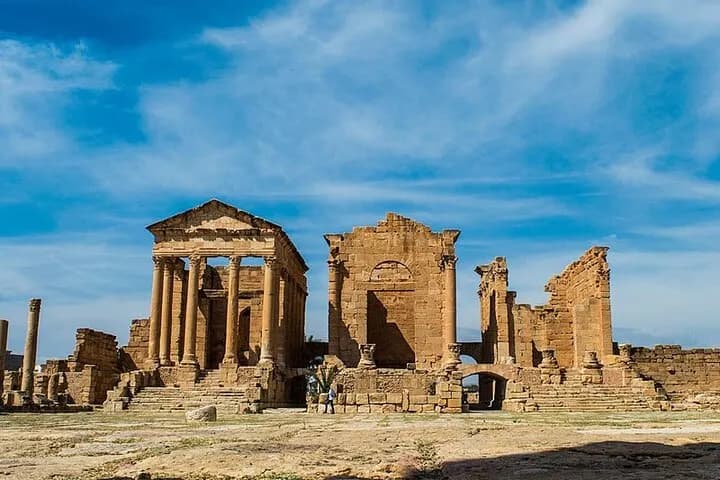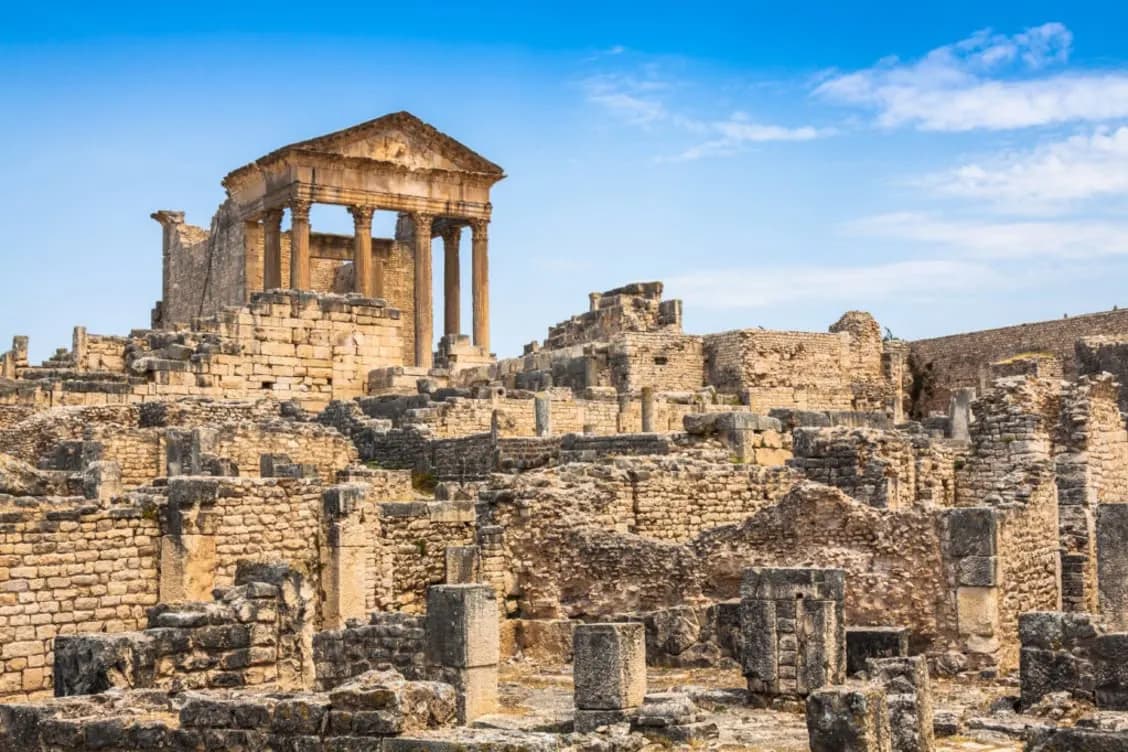

The ruins of Carthage are the scattered remains of one of antiquity's greatest cities — a Phoenician sea-power that once rivalled Rome, was razed to the ground, then rebuilt into one of the largest capitals of the Roman Empire — spread today across a leafy seaside suburb just northeast of Tunis.
Quick answer: Carthage is an ancient Punic and Roman city on the Gulf of Tunis, about 15 km northeast of central Tunis, now a UNESCO World Heritage Site scattered across a modern residential suburb. It is not one enclosed park but a series of separate sites — Byrsa Hill, the Punic ports, the Antonine Baths, the Roman villas and more — linked by a single combined ticket. Allow at least half a day for the highlights, or a full day to see everything and add nearby Sidi Bou Said.
What is Carthage?
Carthage was, for the better part of a thousand years, one of the most important cities in the Mediterranean world. It began as a Phoenician trading colony and grew into the capital of a maritime empire whose ships, merchants and colonies dominated the western Mediterranean — from the coasts of North Africa to Sicily, Sardinia and southern Spain. Its long rivalry with Rome produced some of the most famous conflicts of antiquity, including Hannibal's audacious crossing of the Alps with his war elephants. When Rome finally destroyed the city in 146 BC, the victory was so total that its name became a byword for a civilisation wiped from the map — and yet, within a century, Rome rebuilt Carthage as one of its own grandest cities.
Today the name covers two overlapping stories. Punic Carthage was the Phoenician-founded sea-power — the word "Punic" simply derives from the Latin term for Phoenician — while Roman Carthage was the imperial capital that rose on the same hills after the conquest. Both left their mark on the ground, and both are what you come to see. Understanding that double identity is the key to enjoying a visit: you are walking through the ghosts of two great cities layered on the same slopes. If you want an at-a-glance overview before diving into the detail, our Carthage destination page sets the scene, and for the wider country context there is our complete guide to travelling in Tunisia.
Where are the ruins of Carthage?
Carthage sits on the coast of the Gulf of Tunis, roughly 15 km northeast of the centre of Tunis. What was once a great walled metropolis is now an affluent residential suburb of the Tunisian capital — one of the most desirable addresses in the country, home to foreign embassies, discreet villas behind high walls, and the presidential palace. That setting is the single most important thing to grasp before you go, because it changes what a visit actually feels like.
The remains are not gathered into one enclosed archaeological park. Instead they are scattered across the suburb in a dozen or so separate fenced sites, tucked between modern houses, jacaranda-lined gardens and quiet residential streets. You walk or ride between them. This layout surprises first-time visitors and shapes how you plan your day: Carthage is an unhurried treasure hunt across a hillside above the sea, not a single dramatic monument you photograph and leave. The reward is atmosphere and space — you rarely feel crowded — but it asks for a little patience and imagination. For a sense of the mood on the ground, read a slower, first-hand walk through the Punic and Roman ruins.
History of Carthage (a brief chronology)
Few places pack so much history into one hillside. Here is the short version, from Phoenician colony to Arab conquest.
- c. 814 BC — Phoenician settlers from Tyre found the city. Legend credits Queen Dido (also called Elissa). Its Punic name, Qart-Hadasht, means simply "new city".
- 6th–3rd c. BC — Carthage becomes the dominant maritime and trading power of the western Mediterranean, with colonies and trading posts across North Africa, Sicily, Sardinia, Malta and Spain.
- 264–146 BC — Three Punic Wars against Rome. In the Second (218–201 BC), Hannibal famously crosses the Alps to invade Italy and wins crushing victories, only for Rome to prevail in the end.
- 146 BC — The Roman general Scipio Aemilianus takes and destroys Carthage after a long siege, ending the Punic empire. The site is cursed and largely abandoned.
- 1st c. BC — Julius Caesar plans, and Augustus completes, a Roman refoundation as Colonia Julia Carthago. It becomes capital of the province of Africa Proconsularis and one of the empire's largest cities.
- 2nd–4th c. AD — A flourishing early-Christian centre. The theologians Tertullian and St Cyprian are linked to the city, and St Augustine studied and taught here as a young man.
- 439 AD — The Vandals capture Carthage and make it the capital of their North African kingdom.
- 533 AD — The Byzantine general Belisarius reconquers the city for the Eastern Roman Empire.
- 698 AD — The Arab conquest. Carthage declines rapidly as the newly rising city of Tunis, just inland, takes its place as the regional capital.
- 1979 — The archaeological site of Carthage is inscribed as a UNESCO World Heritage Site.
Punic Carthage
Punic Carthage is the harder half to picture, precisely because Rome tried so hard to obliterate it. The city that Hannibal defended was largely destroyed in 146 BC, and Roman rebuilding sat directly on top of much of what remained. Even so, genuine Punic remains survive, and finding them is one of the quiet thrills of a visit. This was a city of double and triple defensive walls, of dense multi-storey housing, and of a religion centred on the deities Baal Hammon and the goddess Tanit, whose distinctive stick-figure symbol you will spot again and again on carved stelae.
The most tangible traces cling to the slopes of Byrsa Hill, where excavations have uncovered part of a Punic residential district — sometimes nicknamed the "Hannibal quarter" — with the foundations of houses, narrow streets and drainage laid out much as they were in the city's final century. The great circular and rectangular ports were also Punic engineering long before the Romans reused them. And south of the centre lies the Tophet of Salammbô, a sacred open-air precinct crowded with hundreds of carved stone markers and urns — one of the most evocative Phoenician-Punic sites to be found anywhere in the Mediterranean. Manage your expectations, because the Punic city is fragmentary and low to the ground, but with a little imagination — and ideally a guide to read the stones for you — it comes vividly alive.
Roman Carthage
Roman Carthage is the more visible city, and most of the standing masonry you will see belongs to it. After Augustus completed the refoundation, Carthage swelled into a metropolis of perhaps several hundred thousand people, reckoned second only to Rome itself in the western empire. Baths, theatres, an amphitheatre, temples, an immense circus for chariot racing and grand terraced villas spread across the hills above the gulf, all fed by one of the ancient world's great engineering feats: an aqueduct that carried water more than 130 km from the mountains near Zaghouan to the vast cisterns of La Malga.
The showpiece for most visitors is the seafront bath complex, but the Roman layer is everywhere — in the villa terraces with their mosaic floors, in the theatre still used for performances, in the water infrastructure that sustained the city, and in the amphitheatre remembered as the place where the Christian martyrs Perpetua and Felicitas met their deaths in 203 AD. If Carthage whets your appetite for Roman Africa, it pairs beautifully with the greater sites of the interior — the colossal amphitheatre of El Jem, the hillside temples and theatre of Dougga, and the forum and churches of Sbeitla. Together they tell a fuller story of Roman North Africa than any single site can.
Byrsa Hill
Byrsa Hill is the acropolis and historic heart of Carthage — Punic first, then Roman — and the natural place to begin your visit. This is where legend says Dido founded the city, cutting an ox-hide into thin strips to claim as much land as the strips would encircle (the name Byrsa is popularly linked to the Greek word for hide). In Punic times it held the great temple of Eshmun, the healing god, and in the Roman era its summit was sheared flat and raised onto an artificial platform to carry a monumental forum and civic centre.
Today the hilltop is crowned by the Carthage National Museum, whose collection of Punic and Roman finds — stelae, statuary, mosaics, jewellery and everyday objects — gives essential context to everything scattered below. Beside it stands the striking former Cathedral of Saint-Louis, a 19th-century landmark now used as a cultural venue. On the slopes lie the exposed foundations of the Punic residential quarter, a rare window onto how ordinary Carthaginians actually lived. Best of all are the views: from the top you look out over the whole archaeological zone, the sweep of the Gulf of Tunis and, on a clear day, the white-and-blue village of Sidi Bou Said perched on its distant headland. Start here to orient yourself both geographically and historically.
Carthage Harbour (the Punic ports)
If any single feature captures the genius of Punic Carthage, it is the ports. Ancient writers such as Appian described a naval harbour so sophisticated that visitors marvelled at it, and its footprint is still legible in the landscape today, near the modern seafront neighbourhood of Salammbô. To stand at the water's edge here is to look at the very engine of Carthaginian power.
There were two linked harbours. The outer, rectangular commercial port handled merchant shipping — the trade in silver, tin, textiles and grain that made Carthage rich. Behind it lay the astonishing circular military port, or cothon, a perfect ring of water enclosing a central artificial island that served as the admiralty. Covered ship-sheds ranged around the ring could shelter and service a war fleet — by some ancient accounts as many as 220 warships — out of sight of the open sea, a feat of naval planning far ahead of its time. What survives now is largely the shape of the two lagoons rather than tall structures, so you read the ancient plan in the curve of the water and the land; a small port and oceanographic museum on the central island helps you reconstruct what once stood here.
The Antonine Baths
The Baths of Antoninus Pius, built in the 2nd century AD, are the single most impressive standing monument in Carthage and the highlight for most visitors. They were the largest Roman baths in Africa and among the largest in the entire empire, ranking behind only the imperial baths of the city of Rome itself — a vast thermal complex set right on the seafront, where bathers moved between the hot, warm and cold rooms with the sea breeze at their backs.
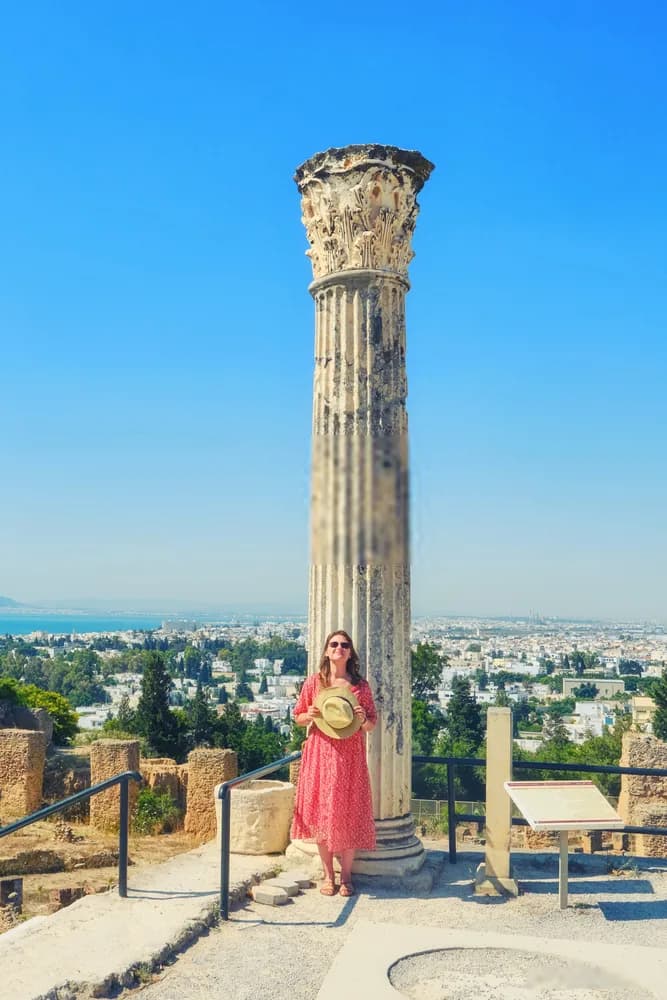
Much of the upper structure is long gone, but what remains is still monumental: soaring columns, huge fallen capitals the size of a small car, and the massive lower level of service galleries and furnaces that once supported the bathing halls above. A single re-erected column gives a hint of the original scale, rising far overhead and hinting at a building whose vaults would have towered many storeys high. The setting is unbeatable — ruins of imperial ambition framed by the deep blue of the Gulf of Tunis — and this is where most people take their defining photograph of Carthage. Allow plenty of time here to wander the seaward terraces and let the sheer size of the place sink in.
The Roman villas
A short distance uphill lies the residential quarter of Roman Carthage, a district of terraced villas that once belonged to the city's wealthy merchants and officials. The star is the so-called Villa of the Aviary (Villa des Volières), named for a fine mosaic of birds, with a peristyle garden that has been partly reconstructed — columns re-raised, planting restored — to suggest how these elegant homes looked in their prime. It is one of the few places in Carthage where you can stand inside a Roman living space rather than merely beside a foundation, and imagine the shaded colonnade, the splash of a fountain and the view down to the sea.
Close by are the Roman theatre and the smaller odeon — the theatre restored and still used for concerts and festivals to this day — together with an archaeological park that ties the neighbourhood together. Between them, these sites round out the picture of daily life in the imperial city, spanning the whole social scale from the grandeur of the public baths to the private comfort of a garden courtyard. If you would rather have the stories drawn out for you as you walk, consider the guided Carthage Punic and Roman ruins experience.
How long to visit
Plan around the fact that Carthage is spread out and that time disappears in the walking between sites. A brisk visit hitting only the two or three must-sees — Byrsa Hill and its museum, the Antonine Baths and the ports — takes about half a day, roughly three to four hours including travel between the sites. To do the whole ensemble justice, adding the villas, the theatre, the Tophet and the cisterns, set aside a full day and take it slowly.
A very popular use of a full day is to combine Carthage with Sidi Bou Said, which sits just up the coast (more on that below). If you are trying to fit Carthage into a wider trip and wondering how the days add up overall, our guide to how many days you need in Tunisia puts it in context and helps you balance the coast, the ancient sites and the desert.
How to get there from Tunis
Carthage lies just northeast of Tunis, a short hop from the city and easy to fold into a day out. With Atlantis Voyages you never have to think about how to get there: your transport is arranged for you, door to door and in private comfort, both to Carthage and between its scattered sites. And it does not stop at Carthage — Atlantis Voyages looks after your transport throughout your entire stay in Tunisia, from the airport to every stop on your itinerary, so you spend your time enjoying the country rather than working out logistics.
That matters more here than at most attractions, because Carthage is spread across a suburb and the sites sit some distance apart. Having a driver and guide on hand means you move straight from Byrsa Hill to the Antonine Baths to the ports without the long walks or the waiting — a real advantage in the summer heat. If it is your first trip, our first-time visitor FAQ and our honest take on whether Tunisia is safe to visit answer the questions most people ask before they go.
Carthage + Sidi Bou Said itinerary
This is the classic day out from Tunis, and for good reason. Sidi Bou Said — the famous blue-and-white clifftop village — sits just a short way beyond Carthage along the same coast, so the two combine naturally into a single day. A well-paced day looks like this:
- Morning: Start at Byrsa Hill and the Carthage National Museum for orientation and the best views, then walk down to the Antonine Baths on the seafront while the air is still cool.
- Midday: Continue to the Punic ports and, if time allows, the villas and the theatre. Pick up a quick lunch in Carthage, or hold out for the cafés of the village.
- Afternoon: Continue the short way on to Sidi Bou Said. Wander the cobbled lanes, admire the studded blue doors and courtyards, and finish with a mint tea overlooking the marina as the light softens.
The pairing works because the two places are complementary: Carthage is ancient history and monumental scale; Sidi Bou Said is atmosphere, colour and cafés. Do the ruins first, while you have the energy for walking and reading, and save the village for a relaxed finish to the day.
Best time to visit
Carthage is open-air and, crucially, offers little shade. That makes timing matter far more than it would at a covered attraction. Spring (March to May) and autumn (September to November) are the most pleasant seasons — warm, clear and comfortable for walking between the sites, with wildflowers on the slopes in spring. Winter is mild but can bring showers and grey skies; the ruins are still perfectly rewarding on a bright, crisp day, and you will often have them almost to yourself.
In summer, the middle of the day on the exposed hillsides can be genuinely punishing, so start early in the morning, carry water, and wear a hat. The sea breeze at the Antonine Baths brings some relief, but the open walk between sites does not. For a fuller seasonal breakdown across the whole country, see our guide to the best time to visit Tunisia.
Tickets and practical information
The single most useful thing to know is that a combined ticket covers the whole archaeological ensemble — all the main fenced sites, plus the National Museum, on one ticket. Buy it at the first site you enter and keep it safe; you simply show it again at the gate of each subsequent site. There is no need to queue and pay separately at every entrance.
- Tickets: One combined admission covers the sites, typically with a small extra fee if you want to use a camera. Prices are low by European standards but change over time — check current rates before you go rather than relying on a fixed figure.
- Opening hours: The sites generally open in the morning and close in the late afternoon, with hours varying by season — shorter in winter, longer in summer. Confirm the current opening hours for the exact day of your visit, and note that gates can close earlier than you expect.
- On the ground: Wear comfortable shoes for uneven terrain, bring sun protection and water, and expect a fair amount of walking between sites. A guide adds a great deal here, because on-site signage is limited and the ruins are dispersed and often unlabelled.
- Budget: Carthage itself is inexpensive to enter, and with Atlantis Voyages your transport and guiding are already part of the trip. For how it fits into a wider budget, see our breakdown of Tunisia trip costs.
Would you rather have Carthage taken care of for you? As Tunisia specialists, Atlantis Voyages covers the whole visit — tickets, expert local guiding and door-to-door transport included, at Carthage and right across your Tunisia trip. Plan your trip with us and we will build Carthage into a tailor-made Tunisia itinerary, guiding included.
Is Carthage worth visiting?
Yes — with the right expectations. For anyone who loves history, standing on the very ground where Hannibal's city rose and fell, and where Rome then built one of its greatest capitals, is deeply rewarding. The coastal setting is superb, the Antonine Baths are genuinely monumental, and the panoramas from Byrsa Hill over the Gulf of Tunis are unforgettable.
The honest caveat is the one we have returned to throughout: Carthage is ruins spread across a modern suburb, not a single dramatic, intact monument like the amphitheatre at El Jem. Some visitors arrive expecting one compact, spectacular site and leave a little underwhelmed; those who come understanding the layout — and who take their time, ideally with a guide — come away captivated. Paired with Sidi Bou Said for the afternoon, it makes one of the best and most accessible day trips in the whole country. Come for the story and the setting, not for a single postcard, and Carthage delivers handsomely.
Frequently asked questions
Where exactly are the ruins of Carthage?
They lie on the Gulf of Tunis coast, about 15 km northeast of central Tunis, in what is now an affluent residential suburb of the capital. The remains are not in one enclosed park but scattered across several separate fenced sites — Byrsa Hill, the Punic ports, the Antonine Baths, the villas and more — all linked by a single combined ticket.
How long do you need to visit Carthage?
Allow at least half a day, around three to four hours, for the highlights of Byrsa Hill, the Antonine Baths and the ports. To see everything at a relaxed pace, or to combine Carthage with Sidi Bou Said, set aside a full day. Remember that much of the time goes on travelling between the dispersed sites.
How do you get to Carthage from Tunis?
Carthage is just northeast of Tunis, a short trip from the centre. With Atlantis Voyages your transport is arranged for you — door to door and in private comfort, both to Carthage and between its scattered sites — and it continues throughout your whole stay in Tunisia, so you never have to work out the logistics yourself.
Is there one combined ticket for all the Carthage sites?
Yes. A single combined ticket covers the whole archaeological ensemble, including the National Museum. Buy it at the first site you enter and show it again at each of the others, so you never pay separately at every gate. Check current prices and opening hours before you go, as both change seasonally.
What is left of Punic Carthage?
Less survives than from the Roman city, because Rome razed Carthage in 146 BC and rebuilt directly over it. Even so, real Punic remains endure: the residential "Hannibal quarter" on the slopes of Byrsa Hill, the unmistakable shape of the great circular and rectangular ports, and the evocative Tophet of Salammbô with its carved stone markers. A little imagination, or a guide, brings them to life.
Can you combine Carthage with Sidi Bou Said?
Absolutely — it is the classic pairing and needs no special planning. Sidi Bou Said sits just beyond Carthage along the same coast. Do the ancient ruins in the morning, when you have energy for walking, then finish with a relaxed afternoon in the blue-and-white village.
Is Carthage worth visiting?
For history lovers and for the coastal setting, very much so. Just come with the right expectations: it is ruins spread across a modern suburb rather than one dramatic, intact monument. Take your time, ideally with a guide, and pair it with Sidi Bou Said for one of Tunisia's best and most accessible day trips.
Is Carthage good for kids?
It can be, with a little planning. Children often enjoy the towering columns of the Antonine Baths, the story of Hannibal and his war elephants, and the circular port where a whole war fleet once hid from view. The downsides are the walking between sites and the limited shade, so keep it fairly short, bring plenty of water, and go early in summer.