
I caught the TGM from the heart of Tunis on an afternoon that couldn't quite decide whether to be hot, and within minutes the city had loosened its grip. The little light-rail carriage swayed along the edge of the Gulf of Tunis, salt air coming in through the windows, and the flat glare of the capital gave way to gardens, umbrella pines and villas the colour of clotted cream. Several stations serve the ruins, each dropping you at a different chapter of the story, and I liked the democracy of that — no grand gateway, no single entrance to file through. You simply step down onto a suburban platform, and Carthage is somehow already all around you, folded into a residential quarter as though the past were just another neighbour.
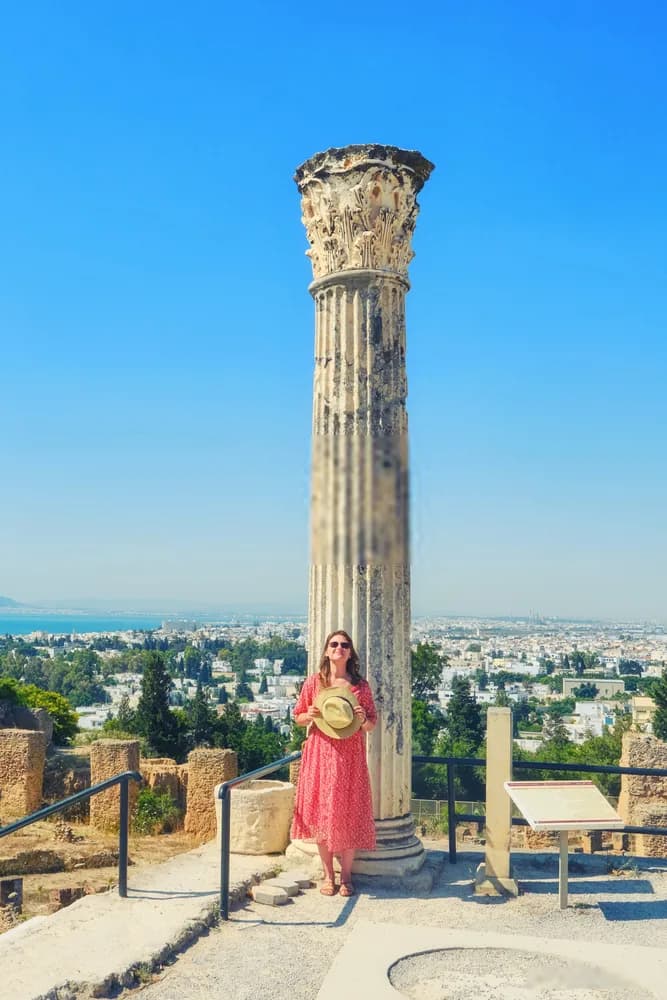
My first climb was up Byrsa Hill, where the Punic quarter and the National Museum sit above everything else. This, I kept reminding myself, was the high ground of the city that rattled Rome for generations — the great rival, founded by Phoenician settlers in the deep antiquity that tradition dates to 814 BC. Standing there among low, honey-coloured foundations, it is hard to reconcile the domestic scale of what survives with the enormity of what happened here. At the end of the Third Punic War, in 146 BC, Rome destroyed the place utterly. And yet the view stopped me: rooftops sloping down to the sea, the water going that impossible Mediterranean blue, and the whole thing so peaceable that the violence in the guidebooks felt like a rumour about somebody else's town.
Down to the Water
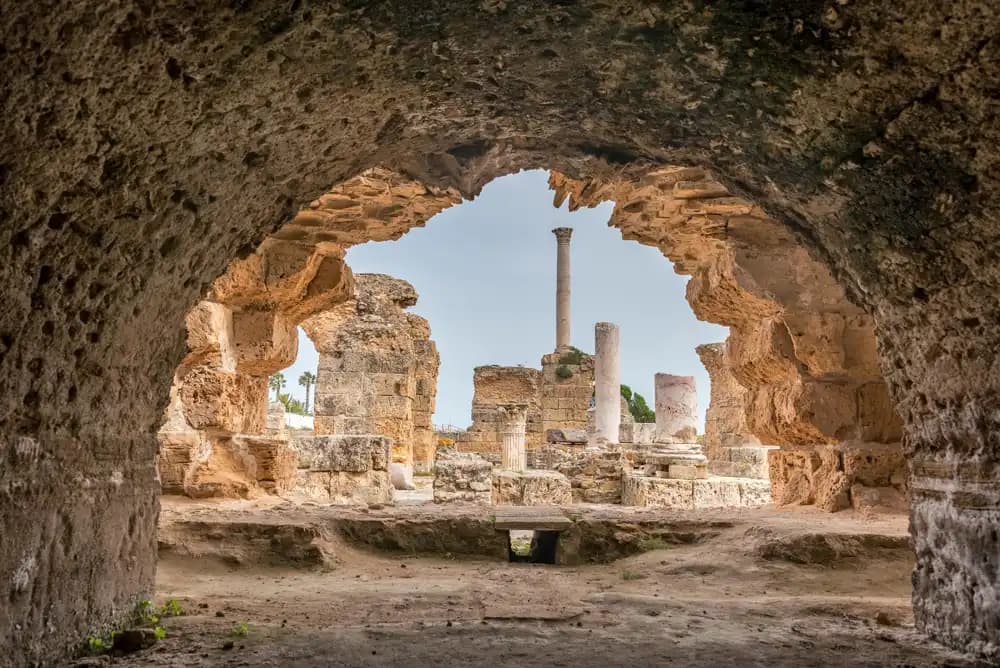
From the hill I walked down towards the shore, to the Baths of Antoninus, and this is where Carthage stopped being an idea and became a body. The bath complex — one of the largest the Romans ever built — spreads right along the seafront, its surviving columns and vaulted stumps standing against the sky with the Gulf immediately behind them. What you see is mostly the underworks, the service level, because the grand floors above have long since gone; but the effect is still staggering, corridors and brick arches marching towards the waves. I sat on a fallen block for a while and let a group of schoolchildren stream past, their voices bouncing off two-thousand-year-old stone, and thought about how this was all raised by Rome after the destruction — the second Carthage, the imperial city built over the memory of the one it had erased.
Not far off lie the Punic ports, and these were the detail that undid me a little. The circular military harbour is quieter now, a calm ring of water in a green suburb, ringed by reeds and the occasional dog-walker. You have to stand still and let your imagination do the heavy lifting, but once it does, the shape of the thing is unmistakable: a perfect basin engineered for warships, the beating heart of a naval power. There were no crowds here, no ropes, no ticket booth theatre — just water, birdsong, and the strange privilege of standing at the edge of something that once terrified the ancient world.
What the Stones Remember
The afternoon slid on, and I gave the rest of it to the softer, sadder corners. I found the Roman theatre with its curve of stone seating, still used, I'm told, when the season allows; and the Roman villas, where mosaics lie half in the open, their fish and vines and geometric borders as crisp as the day some patient hand laid them. Then the Tophet, the ancient sanctuary, where the mood changes entirely — a sunken, shaded place among the stelae that asks for quiet whatever you believe about it. I lingered there longer than I meant to. Carthage has been a UNESCO World Heritage site since 1979, but no listing quite prepares you for how personal these scattered fragments feel when you meet them on foot, one after another, across an ordinary neighbourhood.
What stayed with me, in the end, was the ordinariness — and I mean that as the highest compliment. This is not a ruin sealed behind glass; it is a leafy Tunis suburb that happens to be built over one of the great collisions of history, with cats dozing on Roman thresholds and the sea forever just down the slope. As the light turned gold I walked on towards Sidi Bou Said, the little blue-and-white village next door, and looked back once at the hill. Two civilisations had wanted this ground badly enough to fight to the death for it. Now it belongs to whoever climbs off the train on a slow afternoon, and for a few hours it belonged to me.