
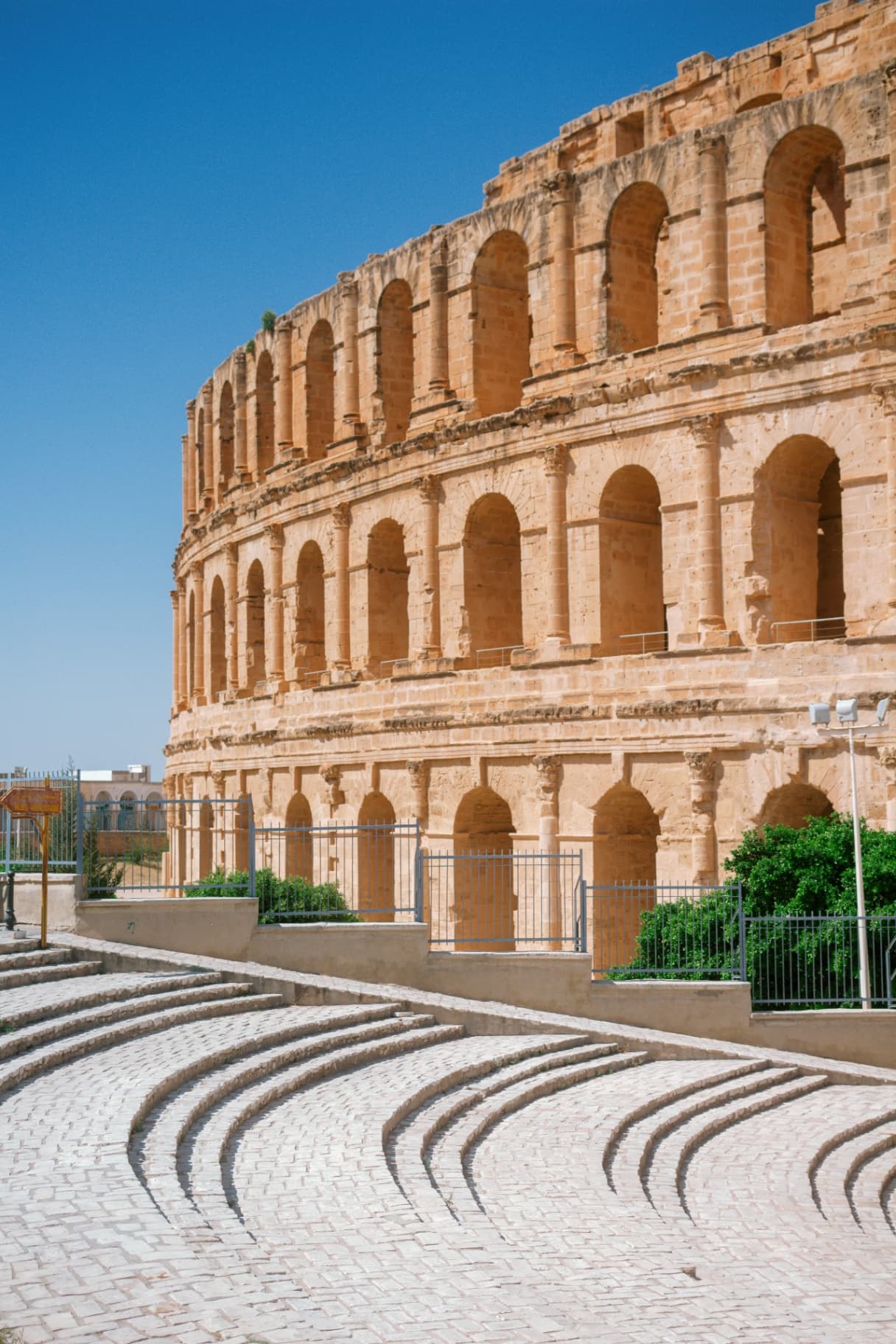
The train south from Sousse does not hurry. It rattles down the Tunis–Sfax line through olive groves and flat, sun-bleached country, and for the better part of an hour you begin to wonder whether you have misjudged the whole excursion — sixty kilometres for a small town you have never heard anyone mention by name. Then, as the carriages slow, something rises above the low rooftops that has no business being there: a wall of arches, tier upon tier, the colour of old honey against a hard blue sky.
I stepped down onto a quiet platform and walked towards it through streets that carried on with their ordinary morning — a café, a man sweeping his doorway, the smell of bread. And all the while the amphitheatre grew, until I turned a final corner and it filled the sky entirely. Three storeys of arcades still stand here, one of the largest amphitheatres the Roman world ever built, and it does not sit politely at the edge of town. The town has simply grown up around its feet, the way a village might settle beside a mountain.
Climbing Through the Arcades
Up close the stone is warm to the touch and pitted by eighteen centuries of weather. I climbed the worn tiers slowly, resting a hand on blocks that Roman masons cut in the early third century, and tried to picture the crowds — some thirty-five thousand of them, they say, packed onto these curving benches under the same fierce sun. This was Thysdrus then, a rich provincial town grown fat on olive oil, and the amphitheatre was its statement of ambition. It is bound up, too, with a moment of real drama: the revolt of 238, when the elderly Gordian I was proclaimed emperor in the province against Maximinus Thrax. From the upper gallery you sense the theatrics of the place, the way every sightline draws you down to the empty oval of the arena floor.
I found a spot on the highest surviving tier and simply sat for a while. Swifts screamed and turned in the openings of the arches. Below, a few other visitors drifted through the shadows like slow hands on a clock face, and beyond the outer wall the plain ran flat to the horizon, silver-green with olives. It was very quiet for somewhere that had once held the roar of a small city.
Down Into the Dark
The most affecting part of the visit lies not up in the light but beneath it. A stair leads down into the underground passages that survive under the arena — the long, narrow corridors where gladiators waited their turn and animals were penned in the dark before being hauled up into the daylight. Standing down there, out of the sun, the temperature drops and the noise falls away, and it is impossible not to think about who last passed this way in earnest, and what they were about to face. I lingered longer than I meant to, running a hand along the cool stone.
Afterwards I walked to the small archaeological museum nearby, where some of the finest mosaics rescued from Roman Thysdrus are laid out — sea creatures, hunting scenes, faces staring back across the centuries with startling directness. It made sense of the amphitheatre: not a ruin dropped from nowhere, but the heart of a wealthy, worldly town. El Jem earned its place on the UNESCO World Heritage list in 1979, and standing on the platform later, waiting for the train back north, I understood why. What stayed with me was not the scale, impressive as it is, but the strange intimacy of the place — a giant you can climb inside, still standing quietly at the end of an ordinary street.