
The road out of Tunis unspools southwest through wheat country, and somewhere past Teboursouk it begins to climb. I had been told Dougga sat on a hill, but I hadn't expected the whole approach to feel like a slow reveal — olive groves giving way to open ridge, and then, cresting a rise roughly a hundred kilometres from the capital, the first broken columns catching the light. Below them the Oued Khalled valley fell away in soft folds of green and gold. I turned off the engine and simply sat for a moment before going in.
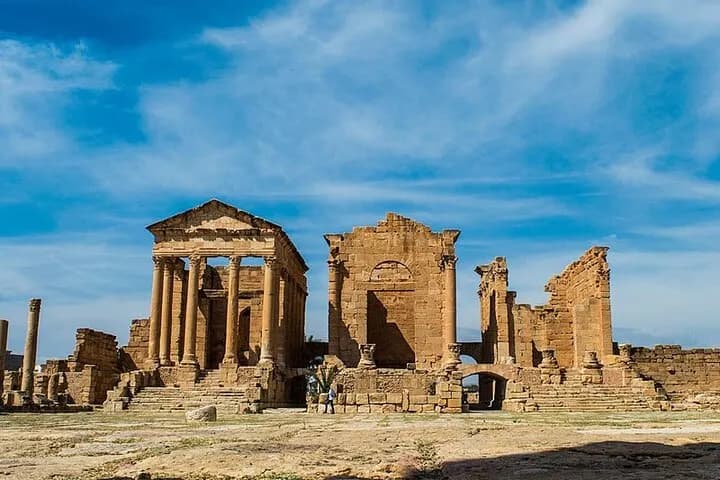
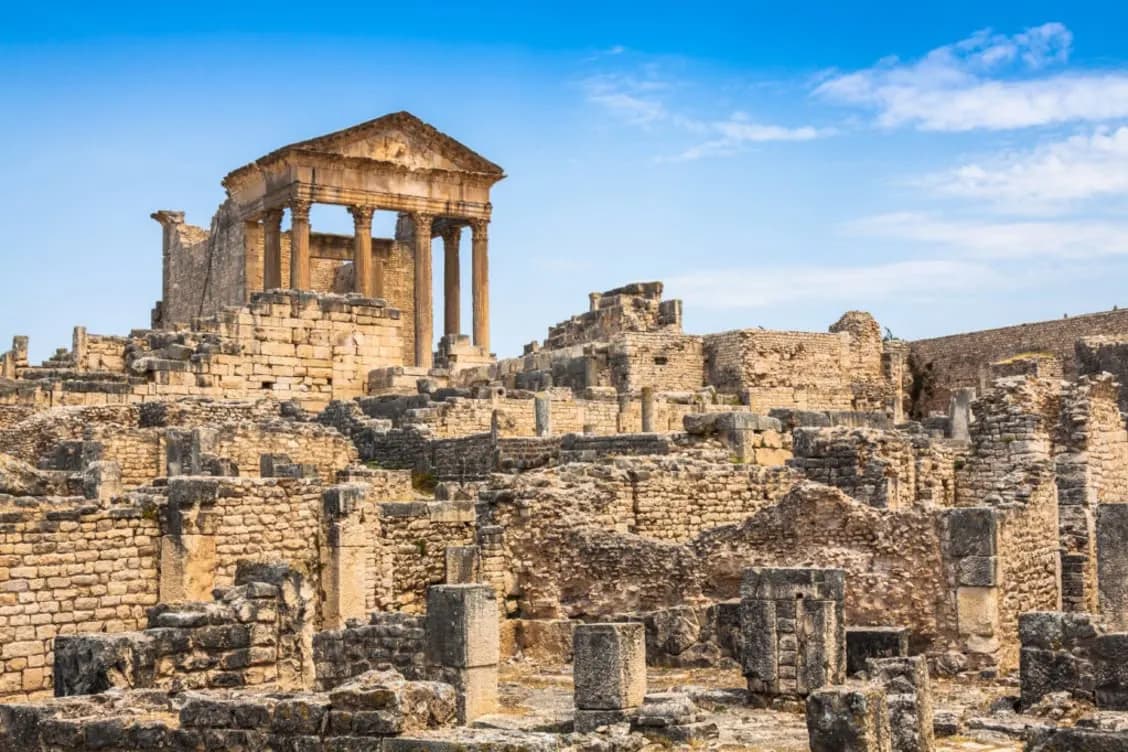
You come to Dougga for the Capitol, and it does not disappoint. The temple raised to Jupiter, Juno and Minerva in the second century still stands with its portico soaring against the sky, its columns holding up the pediment as though the last two thousand years were a rumour someone had exaggerated. I walked up to it slowly, the way you might approach something you don't want to startle. Up close the stone is warm and pitted, honey-coloured where the sun has worked it, and the scale of the thing — that lift of the portico — pulls your eye upward whether you mean it to or not.
Where the ordinary Romans lived
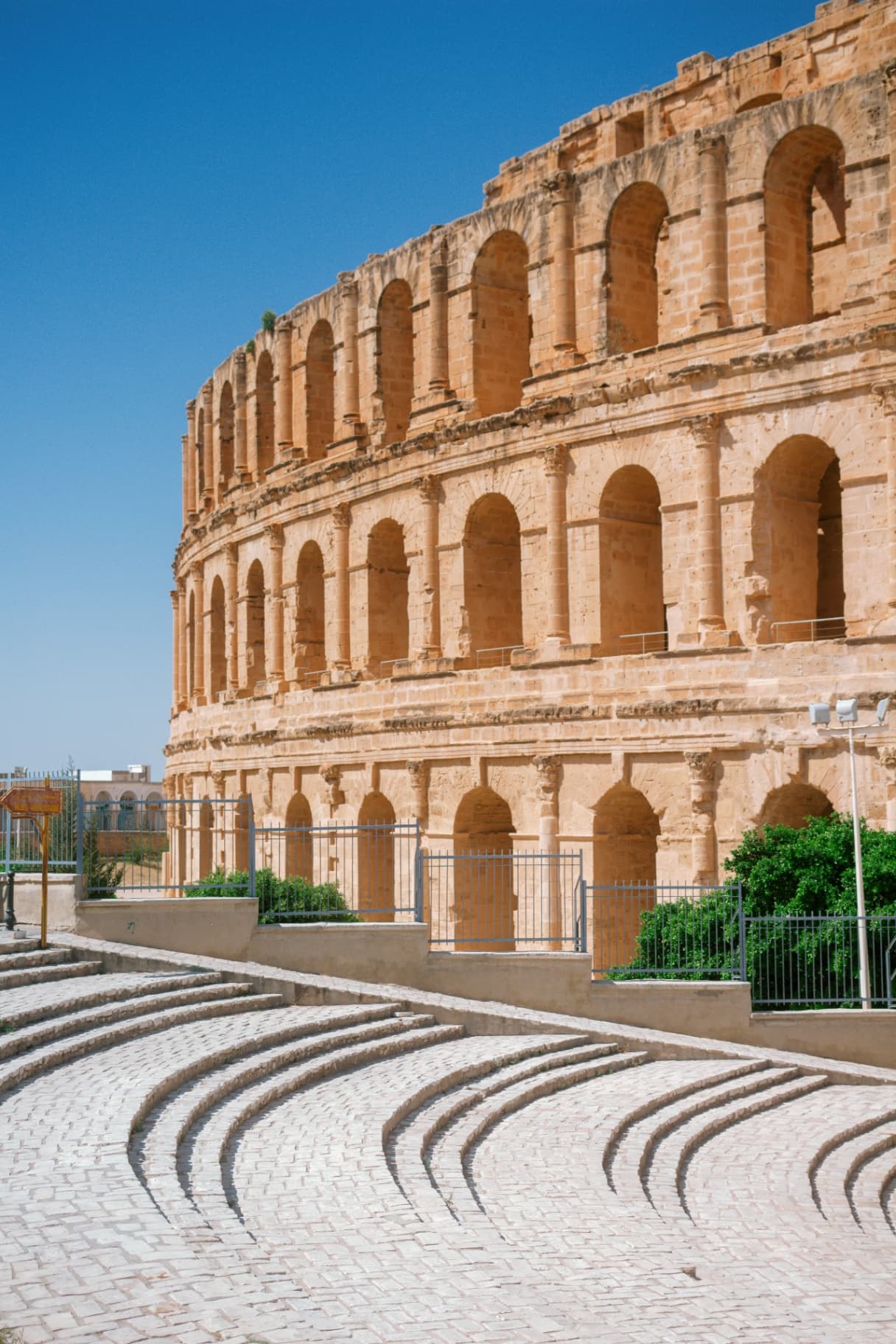
What surprised me was how much of the ordinary town survives. This is Roman Thugga, often called the best-preserved Roman town in North Africa, and the claim earns itself the further you wander. I found the theatre first, its tiers cut into the hillside, still capable of holding an audience of around three and a half thousand and still, remarkably, pressed into service for festivals. Then the Square of the Winds, where a compass rose is carved directly into the paving, its spokes naming the winds that once mattered to people whose whole day turned on the weather. I crouched to trace it with a finger and felt oddly close to them.
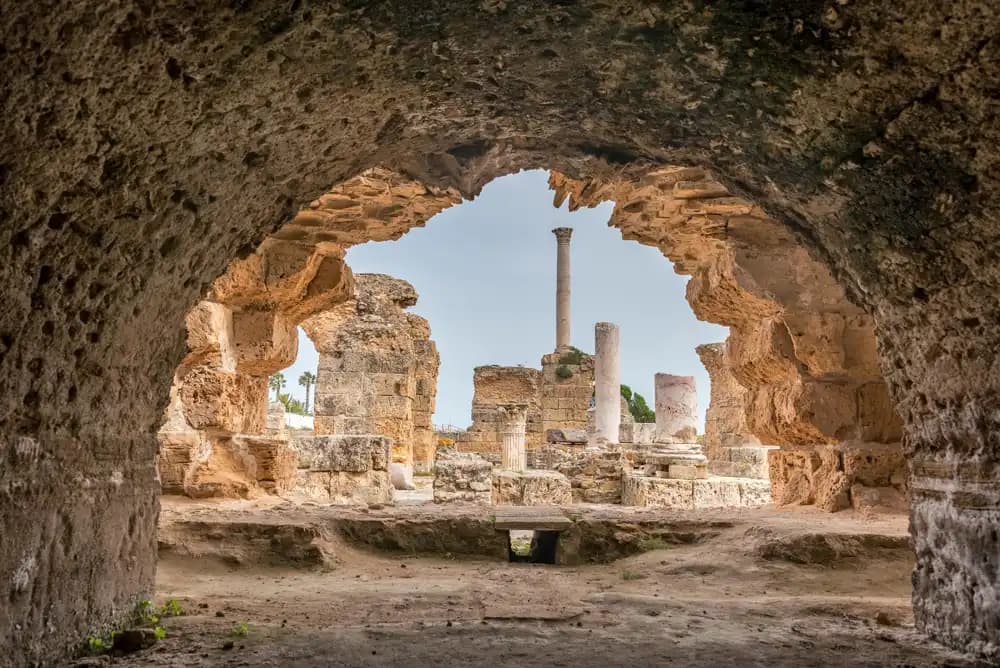
It is the small, unglamorous places that make the past feel peopled. The Licinian Baths sprawl with their vaulted undercrofts, cool even at midday. Nearby are the latrines — communal, companionable, benches set side by side — and the brothel, with its frank little sign. Standing there I stopped thinking of Dougga as a monument and started thinking of it as a neighbourhood: somewhere people bathed and gossiped and grumbled and got on with the business of living. That shift, from ruin to home, is the thing I keep coming back to.
The monument that isn't Roman
For all its Roman grandeur, the moment that stayed with me belonged to something older. Off to one side stands the Libyco-Punic Mausoleum, the tomb of Ateban — a slender, tapering tower that predates the Romans entirely, a rare survival from the Numidian world that was here first. It is a strange and beautiful thing, neither wholly one culture nor another, and it quietly complicates the easy story of a Roman town by insisting that Dougga had a past even before Rome arrived. I stood with it a while, the valley wind pushing at my back.
I left in the late afternoon, when the columns throw long shadows and the whole hill goes amber. Dougga has been a UNESCO World Heritage Site since 1997, and it deserves the honour, but what I carried down the hill wasn't a list of highlights. It was the feeling of having spent a day inside an ordinary town that happened to be extraordinarily old — the compass rose under my finger, the portico against the blue, the little tower that remembered a world before Rome. I would go back tomorrow if I could.