
The road to Sbeitla runs inland, away from the coast and its easy blue, into the centre-west of Tunisia where the country turns the colour of straw and old bone. I had come from the direction of Kasserine, and for a while the landscape gave nothing away — low hills, a few olive trees, the occasional herd drifting across the verge. Then, almost without ceremony, the ruins were simply there beside the road, pale and enormous, with no queue and none of the fuss that surrounds the sites everyone can name. Sbeitla is not on the UNESCO list the way El Jem, Dougga and Carthage are, and that morning I was quietly glad of it.
You enter through the triumphal arch of Antoninus Pius, and it does exactly what a Roman architect meant it to do: it frames what comes next and makes you slow down. I stood under it for a moment, feeling the temperature drop in its shadow, and looked ahead to the forum. This was Sufetula once — a working Roman town with its own name, its own citizens, its own ambitions — and walking through that gateway I had the odd sensation of being expected.
Three temples where there should be one
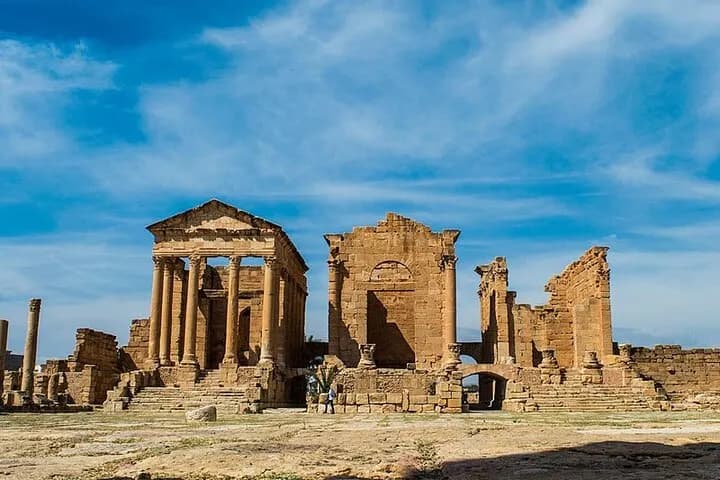
What stops you, once you are in the forum, is the trio of temples standing shoulder to shoulder along one side. I had read about them beforehand and still wasn't ready for it. In most Roman towns the Capitoline triad — Jupiter, Juno and Minerva — share a single temple, the three of them under one roof. Here the builders gave each god a temple of their own, three separate façades side by side, so that the whole western edge of the square becomes a wall of columns and pediments. It is a strange, emphatic thing to see, as if the town wanted to say its prayers three times over.
I sat on a fallen block for a long while and simply watched the light move across the stone. There was almost no one else — a caretaker somewhere out of sight, a bird working the cornices, the wind doing the rest. The columns went from grey to honey to a pale gold as the sun climbed, and the three doorways stood open onto nothing but sky. That emptiness is the thing I keep returning to: a forum built for crowds, holding only me and the heat.
An empire's last stand
Beyond the forum the story changes register. Later hands built early Christian churches here, Byzantine basilicas and baptisteries, and some still hold their mosaics — geometric patterns and the worn shapes of a faith that arrived long after Jupiter had gone quiet. Crouching at the lip of a baptismal font, tracing the tiles with a fingertip, I felt the centuries fold over one another: pagan, then Christian, then the great turning that came next.
For it was here, in 647, that the Byzantine governor Gregory the Patrician proclaimed himself emperor, breaking with Constantinople and staking everything on this inland town. An Arab army met him and defeated him, and with that defeat the long Byzantine hold on North Africa began to loosen. Standing in the ruins, it is difficult to conjure the noise of it — the ambition, the panic, the end of one world and the start of another — because the place is so utterly still now.
What stayed with me from Sbeitla was not any single stone but that stillness, and the feeling of having the whole arc of it to myself: Rome's confidence in the three temples, the softer devotion of the churches, and the abrupt full stop of 647. I left through the arch the way I had come in, and looked back once. The three pediments were still there, side by side, keeping their own counsel in the middle of the country.
Frequently asked questions
What makes Sbeitla's three temples special?
Most Roman towns honour the Capitoline triad — Jupiter, Juno and Minerva — in a single temple. Sbeitla gave each god a temple of their own, three façades side by side, which is rare in the Roman world.
How long do you need at Sbeitla?
About one to one and a half hours around the forum. It's usually quiet, so you can take your time.
Is Sbeitla a UNESCO site?
No, unlike El Jem, Dougga and Carthage — but its preservation makes it one of Tunisia's finest Roman towns, and far less crowded.
See also — other Roman sites in Tunisia: El Jem · Dougga · Carthage. Planning a trip? Read our complete Tunisia travel guide.