
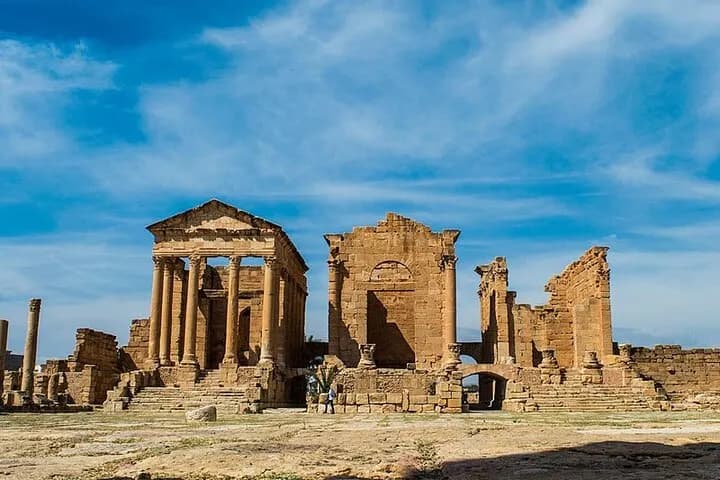
Come up over the low ridge and the temples are already waiting: three of them in a row, honey-coloured stone raised together at the head of the forum, standing against a wide and open sky. Pass through the triumphal arch of Antoninus Pius, the square's formal entrance, exactly as a Roman visitor once did — and stop in the middle. The three facades rise in front of you at once, one temple each for Jupiter, Juno and Minerva.
That is the point of coming this far inland. Most Roman towns gave the three chief gods a single Capitol under one roof; ancient Sufetula built each a temple of its own, side by side. It reads as one deliberate gesture, and the gaps between the buildings frame clean lines of sky.
What to look for
- Stand in the middle of the forum, look up, and take in the three temples together — the signature view and the reason for the drive.
- Walk through the Arch of Antoninus Pius, the original way in, before you step into the square.
- Cross to the early Christian Byzantine churches and baptisteries at the site's edges, where mosaic floors are still legible underfoot.
- Come in the first or last hour of daylight — the ground is open with little shade, and low sun rakes every carved edge.
Sbeitla holds one outsized moment in the record. In 647 AD the Byzantine governor Gregory the Patrician proclaimed himself emperor here, and was defeated by an Arab army that same year — a turning point for Byzantine North Africa. Standing in this quiet forum, it is worth remembering that the plateau was, briefly, the hinge on which the region turned.
Sufetula lies in Tunisia's centre-west, near Kasserine and well inland from the coast, which is part of why it stays uncrowded. Unlike El Jem, Dougga and Carthage it carries no UNESCO listing, so expect fewer visitors and lighter signage. Allow two to three hours to walk the forum, the arch and the churches at an unhurried pace.