
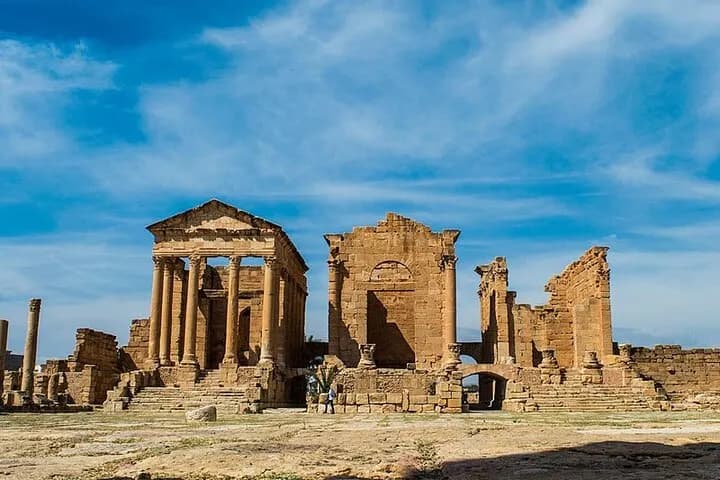
Three temples against a dry sky
You come around the low ridge and there they are: three temples in a row, honey-coloured stone raised on a shared platform, standing against a wide and cloudless sky. Nothing crowds them. The steppe runs flat to the horizon, olive trees scatter the middle distance, and the light does most of the work — sharpening every cornice at dawn, flattening the whole plateau to gold by late afternoon.
Most Roman towns gave their forum a single Capitol. Sufetula built three, side by side, and eighteen centuries later the trio still reads as one deliberate gesture. It is the signature image of the site and the reason to make the drive into the interior. Stand in the old forum square, look up at the three facades, and the arrangement explains itself before any guidebook does.
Sufetula — a Roman town on the edge of the steppe
Sufetula grew up on the semi-arid plateau of centre-west Tunisia, where the coastal plains give way to dry, open country. It was never a great port or a provincial capital, but it prospered on something the region has always produced in quantity: olives, and the oil pressed from them. Stone olive presses still lie among the ruins, plain evidence of what paid for the temples and the paved streets.
That agricultural wealth built a town of real ambition — a colonnaded forum, baths, a triumphal arch, houses with mosaic floors. Because Sbeitla sits inland and off the busiest tourist routes, its ruins are unusually open and quiet. You are rarely hemmed in by crowds, and the scale of the place is easy to take in on foot.
The forum with three temples — why this is rare
The heart of Sufetula is its forum, a paved rectangular square once ringed by porticoes. At its far end stand the three temples, and this is what sets Sbeitla apart. They are dedicated to the Capitoline triad — Jupiter, Juno and Minerva — the three chief gods of Roman state religion.
In most Roman cities the triad shared a single Capitol, one building with three chambers. Sufetula instead gave each deity a temple of its own, three separate structures raised together at the head of the square. That arrangement is unusual enough that the forum is worth crossing the country to see. The three facades survive to a height that lets you feel the original proportion, and the gaps between them frame clean lines of the sky.
The Arch of Antoninus Pius
The formal entrance to the forum is a triumphal arch dedicated to the emperor Antoninus Pius, dated to around 139 AD. You pass beneath it to enter the square, exactly as a Roman visitor would have done, and the temples rise ahead as you step through. It is a small, well-composed piece of theatre, and it dates the forum's grand phase with useful precision.
After Rome — Byzantine churches and the baptistery of Vitalis
Sufetula did not empty out when Roman power waned. It carried on into the Byzantine centuries as a Christian town, and some of its most rewarding remains belong to that later age. Several churches have been excavated across the site, and Sbeitla holds a notable concentration of early-Christian architecture.
The best known is the Baptistery of Vitalis — a Byzantine Christian baptismal font decorated with fine mosaics, its patterned floor still legible where you stand over it. It is a quiet counterpoint to the pagan temples: the same town, a few centuries on, worshipping differently but building with the same confidence.
647: where an empire changed hands
Sufetula has one more claim on history, and it is a large one. In 647 AD the patrician Gregory — the Byzantine governor of the province — broke with Constantinople and proclaimed himself emperor here at Sufetula. His revolt did not last.
That same year the town became the setting for the first great Arab-Muslim battle in Ifriqiya. Gregory was defeated and killed, and the balance of power in the region began to tip decisively. Standing in the forum, it is worth remembering that this quiet plateau was, for a moment, the hinge on which North African history turned.
A provincial forum on the steppe became, in 647, the place where a Byzantine governor lost both his crown and his empire's grip on Ifriqiya.
Visiting Sbeitla
Sbeitla lies in the interior, a real distance from the coast, and getting there is part of what keeps it uncrowded. On a Tunisia Trip itinerary the transfer is included, so the long drive across the centre of the country is arranged for you and you arrive ready to walk the site rather than worn out by the logistics.
The ruins are spread across an open plateau with little shade, so timing matters. Come early or late and the low sun does the temples justice; come at midday in summer and you will spend more energy shielding your eyes than looking at the stone. Allow roughly two to three hours on the ground to take in the forum, the arch, the temples and the Byzantine churches at an unhurried pace.
One honest note: Sbeitla is on Tunisia's UNESCO tentative (indicative) list, not yet inscribed as a World Heritage Site. It fully deserves the visit on its own merits — just do not expect the crowds, signage or infrastructure of a formally listed monument.
When to go, and what to bring
The centre-west is hot and dry in high summer and can be cold and windy in deep winter. Spring and autumn are the comfortable seasons for walking an exposed site like this one.
- Best seasons: spring (March–May) and autumn (September–November) for mild days and clear light.
- Time of day: early morning or late afternoon — the temples photograph best, and the heat is bearable.
- Water: bring your own; facilities on site are limited.
- Sun protection: hat, sunglasses and sunscreen — there is very little shade on the plateau.
- Footwear: closed, sturdy shoes for uneven paving and rubble.
- Small change: entry is paid locally, so carry some Tunisian dinars.
Roman sites to pair with Sbeitla
Sbeitla is the three-temple forum, but Tunisia's Roman inheritance is deep and varied. If ancient sites are what draw you, these three make natural companions on a longer itinerary — and each shows a different face of Roman North Africa.
- El Jem — the vast, near-complete amphitheatre, one of the largest surviving in the Roman world.
- Dougga — a remarkably intact hilltop town with its Capitol, theatre and temples in a green setting.
- Carthage — the coastal ruins of Rome's great rival, spread above the sea near Tunis.
What survives at Sbeitla
| Feature | Date | Note |
|---|---|---|
| Three temples (Capitoline triad) | 2nd c. AD | Jupiter, Juno and Minerva — three separate temples, rarely built this way |
| Arch of Antoninus Pius | ~139 AD | The formal entrance to the forum |
| Forum square | 2nd c. AD | Paved rectangle once ringed by porticoes |
| Baptistery of Vitalis | Byzantine era | Christian baptismal font with fine mosaics |
| Byzantine churches | 5th–7th c. AD | Several excavated across the site |
| Gregory's revolt and battle | 647 AD | First great Arab-Muslim battle in Ifriqiya |
Half a day at Sbeitla
- 0:00 Arrive and orient — Step onto the plateau and take in the open layout of the site before diving in.
- 0:15 Arch of Antoninus Pius — Enter the forum beneath the ~139 AD triumphal arch, as a Roman visitor would have.
- 0:30 The three temples — Stand in the forum square below the trio dedicated to Jupiter, Juno and Minerva — the site's signature view.
- 1:15 Byzantine churches and the Baptistery of Vitalis — Cross to the early-Christian remains and the mosaic baptismal font.
- 1:45 Olive presses and outer streets — Wander the quieter edges of the town — the presses that paid for it all, and the paved lanes.
- 2:15 Last light on the forum — Return to the temples for a final look as the sun lowers, then depart.
Access & essentials
| Entry | ~12 TND, local price, verify on arrival |
|---|---|
| Hours | Daylight hours; verify seasonally |
| Access | Transfer included in your Tunisia Trip itinerary |
| Best season | Spring or autumn |
| Facilities | Limited — bring water, little shade |
| Region | Midwest, semi-arid climate |
| Map | View location on Google Maps |
March 2026, a little after seven in the morning. The plateau was still cold and the light came in low and level across the steppe. I walked up through the Arch of Antoninus Pius with no one else in the forum, and the three temples caught the first sun one facade at a time — Jupiter, then the pair beside it — the stone going from grey to amber as I watched. For a few minutes there was only wind and the sound of my own footsteps on the old paving. It is a small site, easily seen in a couple of hours, but that first light is the thing I remember.
Frequently asked questions
Is Sbeitla worth visiting?
Yes. Its forum keeps three Roman temples standing side by side — an arrangement you will not easily find elsewhere — alongside a triumphal arch and well-preserved Byzantine churches. For anyone drawn to ancient sites, it rewards the drive into the interior, and it is far quieter than the coastal monuments.
How long do I need at Sbeitla?
Around two to three hours covers the forum, the Arch of Antoninus Pius, the three temples and the Byzantine remains at an unhurried pace. It works well as a focused half-day visit rather than a full day.
Why does Sbeitla have three temples?
The three temples are dedicated to the Capitoline triad — Jupiter, Juno and Minerva. Most Roman towns housed all three gods in a single Capitol building; Sufetula gave each deity a separate temple, raised together at the head of the forum. That is what makes the arrangement rare.
Is Sbeitla a UNESCO World Heritage Site?
Not yet. To be honest about it: Sbeitla is on Tunisia's UNESCO tentative (indicative) list but has not been inscribed as a World Heritage Site. It is a significant and rewarding site regardless — just do not expect the infrastructure or crowds of a formally listed monument.
What happened at Sbeitla in 647 AD?
In 647 AD the Byzantine governor Gregory, a patrician, proclaimed himself emperor here at Sufetula. That same year the town saw the first great Arab-Muslim battle in Ifriqiya; Gregory was defeated and killed, a turning point in the region's history.
Are there Christian remains at Sbeitla?
Yes. Sufetula continued as a Christian town into the Byzantine period, and several churches have been excavated. The best known is the Baptistery of Vitalis, a Byzantine baptismal font decorated with fine mosaics that are still legible today.
When is the best time to visit Sbeitla?
Spring and autumn give the mildest weather for walking an exposed site, and early morning or late afternoon gives the best light on the temples. Midday in high summer is hot with almost no shade, so aim for the cooler ends of the day.
How remote is Sbeitla, and how far is it?
Sbeitla sits inland on the semi-arid plateau of centre-west Tunisia, a real distance from the coast. That remoteness is part of its appeal — the ruins stay open and quiet — but it does mean a longer transfer from the coastal towns.
How do I get to Sbeitla?
On a Tunisia Trip itinerary the transfer is included, so the long inland drive is arranged for you and you arrive ready to explore. There is no need to organise your own transport into the interior.
What else can I pair with a visit to Sbeitla?
For more Roman Tunisia, pair it with El Jem's great amphitheatre, the hilltop town of Dougga, and the coastal ruins of Carthage near Tunis. Each shows a different side of Roman North Africa.