
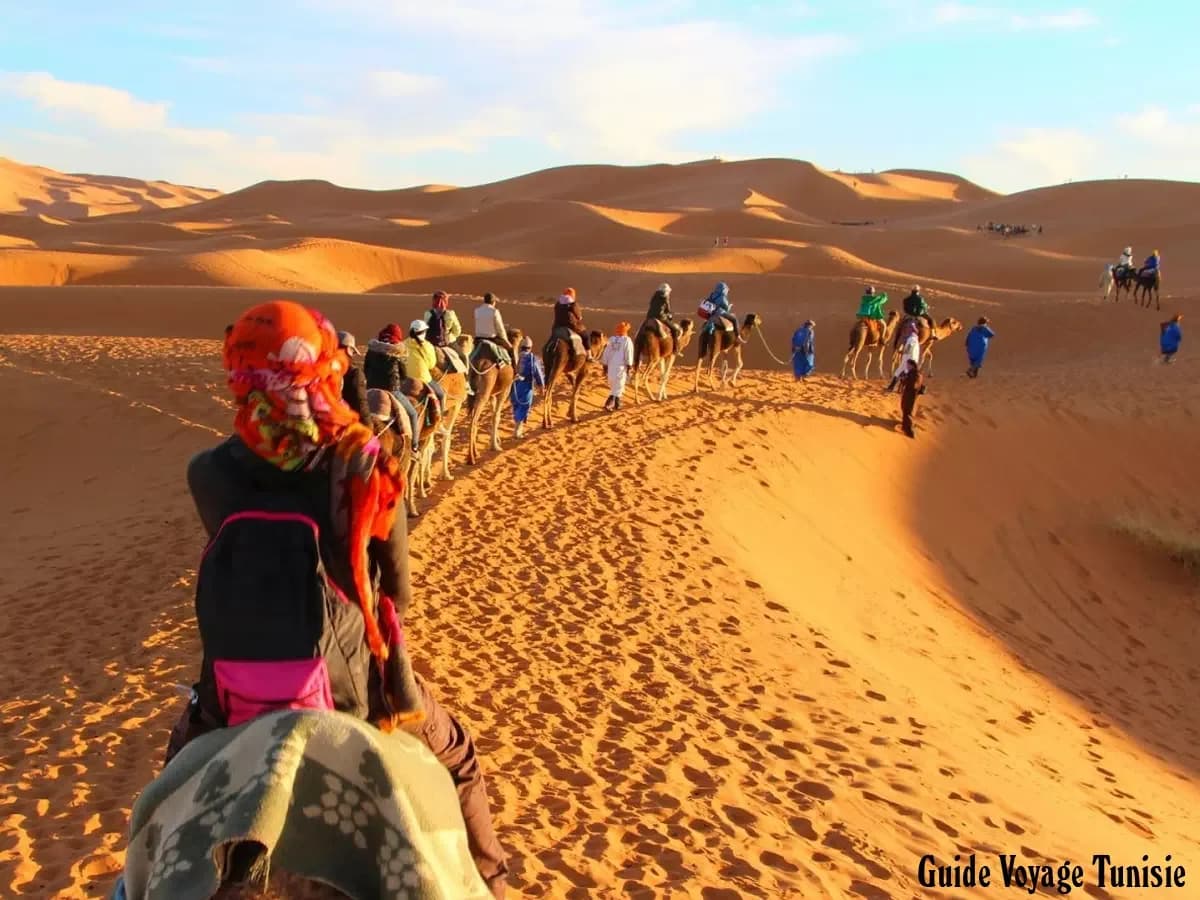
Where the paved roads give out and the sand begins
Douz earns its nickname honestly. This is one of the last proper towns before the Grand Erg Oriental — the vast sand sea that rolls on south and east into Algeria — and the dunes begin almost at the edge of the settlement. Walk past the palm groves on the town's southern side and the hard, scrubby ground gives way to soft golden sand within a short distance. That immediacy is the whole appeal: you do not travel for days to reach the Sahara here, you simply step into it.
The town itself is unassuming — a working oasis settlement rather than a resort — built around a large palm oasis and a market square. Most travellers use it as a base rather than a destination in its own right: a place to sleep, stock up and meet the camel or the 4x4 that will carry them out into the dunes. Keep your expectations grounded and Douz delivers exactly what it promises, which is access to real desert.
Camel treks, 4x4 runs and nights under the stars
The reason to come to Douz is to get out into the Erg, and there are two classic ways to do it. The gentler is a dromedary (camel) trek: you ride or walk out from the palm-grove edge into the dunes, often timed for the softer light of early morning or late afternoon. A short trek lasts an hour or two; longer caravans push deeper into the sand over a day or more. It is slow, swaying travel, and it suits the landscape.
The other is a 4x4 excursion, which covers far more ground and reaches the bigger dunes faster — the better choice if time is short or if you want the thrill of driving the sand. Many itineraries combine the two. Whichever you pick, the dunes themselves are the spectacle: clean ridgelines, shifting colour, and the quiet that falls once the engine stops or the camel settles.
Overnight bivouac camps
The experience most people remember is the overnight bivouac — a desert camp pitched out among the dunes, reached by camel or 4x4. Expect simple tents or Berber-style shelters, a shared meal and, if the sky is clear, a canopy of stars with almost no light pollution to dim it. Sunset and the following sunrise over the dunes are the bracketing highlights; the hours between are about silence and the night sky. Nights can be genuinely cold, so warm layers matter even if the day was hot.
Sunrise, sunset and the stars
If you take only one thing from Douz, make it the light. The dunes are at their most beautiful at the two ends of the day, when the low sun rakes across the sand and throws long shadows off every ridge — the colours shift through gold, apricot and deep orange within minutes. These are the moments the camel treks and camps are built around, and they reward the early start or the overnight stay far more than a midday visit ever could.
After dark, and well away from the town's lights, the Sahara sky is exceptionally clear. On a cloudless, moonless night the stars are dense and bright, and this is a large part of why the overnight camps are worth the modest discomfort. There is no guarantee of perfect conditions — cloud and wind-blown sand happen — but when the sky cooperates it is unforgettable.
The oasis, the market and the town
Douz is not only a launch pad. The town sits in a substantial palm oasis, and a wander among the date palms is a pleasant, shady counterpoint to the glare of the dunes. The weekly market is the other local draw — a genuine regional souk where townspeople and people from the surrounding desert come to trade, rather than a show put on for visitors. It is worth timing a stop around it if your schedule allows; ask locally which day it falls on, as market days can shift.
Each December the town hosts the International Festival of the Sahara, a long-running celebration of desert culture with camel races, folklore performances, music and crowds drawn from across the region. It is a vivid time to visit, but accommodation fills up — if you want to be here for it, book well ahead.
Getting there and how long to stay
Douz lies deep in the south and is usually reached by road from Tozeur (roughly 1.5 to 2 hours, verify locally) or via Gabès on the coast. It pairs naturally with Tozeur and the mountain oases on a southern loop, and many travellers string the two together over a few days. The journey itself is part of the experience, crossing increasingly arid country as you approach the Erg.
For the town you need very little time; for the desert, give yourself at least an overnight. A single afternoon is enough for a short camel trek and sunset over the dunes, but one night at a bivouac camp — with sunset, the stars and sunrise — is what turns a quick stop into a real Sahara experience. On a Tunisia Trip itinerary the transfer and the desert excursion are arranged for you, so you arrive ready to head straight into the dunes.
When to go, and what to bring
The Sahara is a place of extremes, so timing and kit matter more here than almost anywhere else in Tunisia. The season makes the difference between a comfortable trip and a punishing one.
- Best from October to April, when daytime heat is manageable for treks and camps.
- Avoid high summer: the desert is extremely hot and dune excursions become uncomfortable to dangerous in the midday heat.
- Desert nights are cold even after a warm day — pack warm layers, especially for an overnight camp.
- Bring a hat, sunglasses and strong sunscreen; there is no shade out in the dunes.
- Carry plenty of water, and lip balm and a light scarf against sun and wind-blown sand.
- Wear closed shoes you do not mind filling with sand, and a head covering for midday sun.
- If you want the December Festival of the Sahara, book accommodation well ahead.
Douz: an overnight in the Sahara
- Afternoon Arrive and settle in Douz — Reach the oasis town from Tozeur or Gabès, drop your bags, and if the day allows, take a short walk in the palm oasis or a look around the market.
- Late afternoon Set out into the dunes — Head out from the edge of the palm groves by camel or 4x4 into the Grand Erg Oriental, timed so the dunes are at their most beautiful in the low light.
- Sunset Sunset over the sand — Watch the sun go down over the dunes from the camp, as the sand shifts through gold and orange and the air begins to cool.
- Evening Bivouac camp and the stars — Share a meal at a simple desert camp, then take in a clear Sahara night sky with almost no light pollution. Nights are cold, so wrap up warm.
- Dawn Sunrise and return — Rise for sunrise over the dunes — the quietest, most striking hour — then make your way back to Douz and on to the next stop.
Access & essentials
| Getting there | By road from Tozeur (around 1.5-2 hours) or via Gabès from the coast; verify journey times locally. |
|---|---|
| Best season | October to April; avoid the extreme heat of high summer. |
| How long | A half-day covers a short camel trek and sunset; one overnight at a desert camp is far better. |
| Access | Transfer included in your Tunisia Trip itinerary. |
| Facilities | Basic in town (shops, cafés, market); desert camps are simple, so verify what is provided locally. |
| Region | South, Sahara Desert |
| Map | View location on Google Maps |
March 2025. We rode out from the palm-grove edge in the late afternoon, the camels unhurried, and within twenty minutes the town had dropped out of sight behind the first dunes. At the camp the cook lit a fire while the sun went down, turning the sand from gold to a deep rust. After dinner we lay back and the stars came out thick overhead — more than any of us could remember seeing. By dawn it was genuinely cold, and we were glad of the extra layers we had been told to pack.
Read more about Douz
Frequently asked questions
What is Douz known for?
Douz is famous as the 'Gateway to the Sahara', sitting on the northern edge of the Grand Erg Oriental, a vast sea of sand dunes. It is the main jumping-off point for camel treks and 4x4 excursions into the true desert. Though it is a modest oasis town, it is one of the key bases for exploring southern Tunisia.
What are the main things to do in Douz?
The headline experiences are riding a dromedary camel into the dunes and taking a 4x4 excursion across the sand. Sunrise and sunset over the dunes are spectacular, and many visitors stay overnight at a desert bivouac camp. Back in town you can wander the market and the palm-filled oasis.
How do I get to Douz, and how far is it?
Most travelers reach Douz by road from Tozeur, roughly 1.5 to 2 hours away, or via Gabes to the east. Public transport is limited, so a rental car, a private transfer, or a guided tour is the easiest option. Douz is commonly included on southern circuits arranged by operators such as Atlantis Voyages.
How long should I spend in Douz?
A half to full day is enough for a camel ride and sunset over the dunes. If you want an overnight in the desert and a sunrise, plan on one or two days. Many people stop here as part of a wider loop with Tozeur, Matmata and Ksar Ghilane.
When is the best time to visit Douz?
The best season is October to April, when desert conditions are comfortable. Summer, from June to August, is extremely hot and poorly suited to desert activities. Winter nights and early mornings can be cold, so bring warm layers.
What is the International Festival of the Sahara?
Held each December in Douz, it is a celebration of desert culture featuring camel races, folklore, dancing and music. It is one of southern Tunisia's signature events and a great way to experience nomadic traditions. The town gets busy during the festival, so book accommodation well ahead.
What is a camel trek or overnight desert camp like?
Options range from a short ride of a few hours weaving through the dunes to a multi-day caravan with overnight stays. Camping in the desert rewards you with deep silence and some of the clearest star-filled skies you will ever see. Trips are often timed around sunrise or sunset for the best light.
Is Douz worth visiting, and is it family-friendly?
Short camel rides and 4x4 outings suit all ages, making Douz a good stop for families. The scale of the desert and the night sky are hard to match elsewhere, so it is well worth a visit if you are heading into southern Tunisia. Just come prepared for the heat with plenty of water and sun protection.