
A Roman town that never emptied its streets
You climb, and the town assembles itself around you. Not one monument roped off in a field, but streets — worn paving, kerbstones, the ruts of doorways — running between houses, past a market, up toward a temple that has stood for eighteen centuries. Olive groves fall away down the hillside, and beyond them the plains of the interior northwest open flat and gold to the horizon.
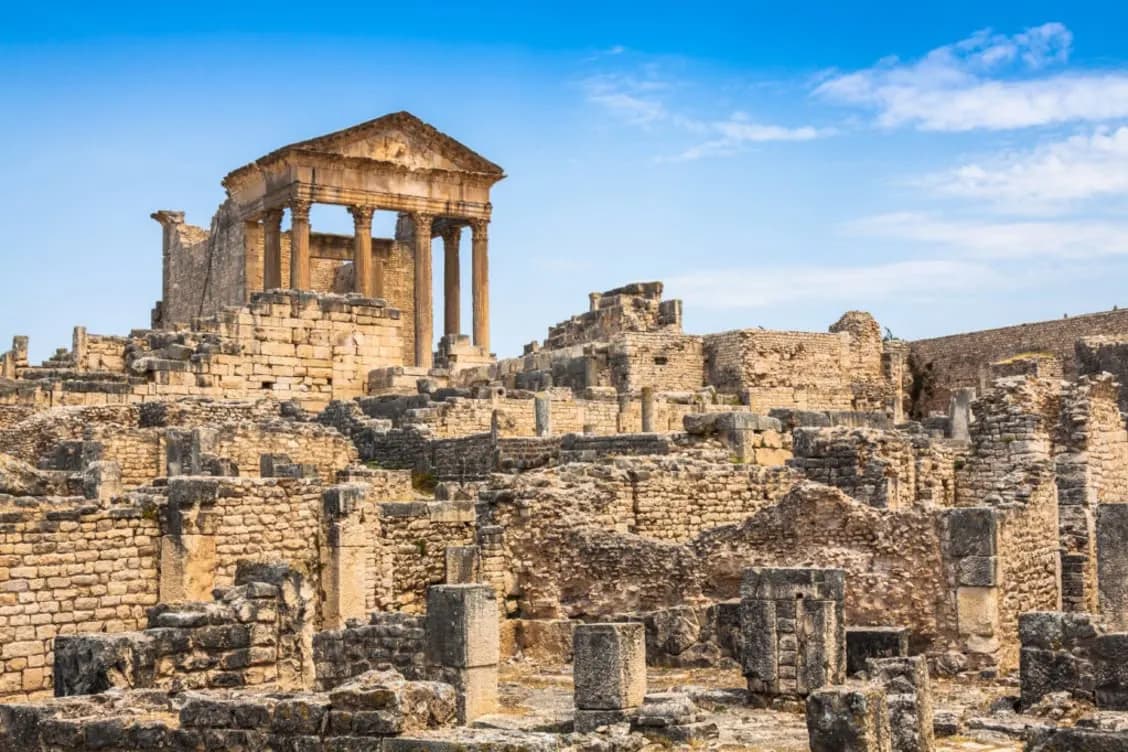
This is Dougga, and the first thing that strikes you is how little you have to imagine. At most Roman sites you rebuild the city in your head from a footprint. Here the Capitol still carries its columns and pediment against the sky, the theatre still holds its curved rows of seats, and the forum still keeps its shape underfoot. You do not tour a ruin. You walk a town that Rome left more or less where it stood.
Most ancient sites give you a plan and ask you to picture the rest. Dougga gives you the streets and lets you simply walk them.
Thugga — a Numidian town that became Roman
Long before Rome, this hillside was Thugga, a town of the Numidians — the Berber kingdom that ruled the interior of what is now Tunisia and Algeria. Its position was practical and old: high ground with water, good land for olives and grain, and a commanding view over the routes below. When Rome absorbed the region, it did not raze the town and start again. It built on top of it.
That layering is what gives Dougga its character. Roman streets follow older Numidian lines, so the grid is irregular, bending with the slope instead of marching in a straight imperial checkerboard. The result is a city that grew rather than one that was stamped down — Punic, Numidian and Roman all pressed into the same hillside.
The Libyco-Punic mausoleum and the inscription in London
Standing apart from the Roman core is one of the oldest things on the site: a Libyco-Punic mausoleum, a slender stepped tower some 21 metres tall, built in the 2nd century BC for a Numidian noble. It is one of the few monuments of pre-Roman North African architecture still standing to its full height, and it predates the Capitol beside it by more than three hundred years.
The mausoleum once carried a bilingual inscription written in both Libyc (the old Berber script) and Punic — a rare key to two ancient languages. In the 19th century that inscription was removed and taken to the British Museum in London, where it remains. Its loss badly damaged the tower, which was later reconstructed. Standing at its base today, you are looking at a monument whose most important text now sits in a glass case a continent away.
A UNESCO site since 1997
UNESCO inscribed Dougga on the World Heritage List in 1997, recognising it as the best-preserved example of a small Roman town in North Africa — a complete picture of provincial life, from monumental temple to public latrine. The listing protects not a single building but the whole hillside settlement, streets and all.
Walking the hillside — Capitol, theatre, forum, market
Dougga rewards wandering. Because the town survives as a town, you move from one kind of Roman life to another simply by walking uphill: civic to sacred to domestic to functional, all within a few hundred metres. Give yourself time to lose the thread and pick it up again.
The Capitol
The Capitol is the monument everyone pictures, and it earns its fame. Built around 166–167 AD and dedicated to the Capitoline triad — Jupiter, Juno and Minerva — it still presents a tall, columned temple front standing almost complete: a deep portico of fluted columns rising to a carved pediment. Few Roman temples anywhere in the empire survive with this much of their façade intact.
Come early and the low sun rakes across the columns, throwing the fluting and the pediment carving into sharp relief. Stand back at the edge of the forum and the temple reads exactly as it was meant to — the visual anchor of the whole town, lifted above everything around it.
The theatre
Cut into the slope just below, the Roman theatre was built around 168–169 AD and seated roughly 3,500 people. Its rows of stone seats climb the hillside in a clean half-bowl, with the stage building and the plains beyond as the backdrop. It is well enough preserved that it is still used occasionally for performances — an ancient auditorium that has not entirely fallen silent.
Climb to the top row and you get the best of both worlds: the theatre below you and the whole town spread out beyond it, Capitol and all.
The everyday buildings
Beyond the headline monuments, Dougga's real gift is the ordinary. The forum still frames its open square. The market keeps the outlines of its stalls. There are temples large and small, bath complexes with their heating channels exposed, and — famously — a communal latrine, its horseshoe of seats intact, one of the frankest reminders anywhere of how Romans actually lived.
Walk the streets and you pass thresholds, drains, olive presses and doorways. It is this accumulation of the everyday, not any single grand building, that makes Dougga feel less like a monument and more like a town caught mid-life.
The best-preserved Roman city in North Africa — why it survived
Plenty of Roman cities were grander than Thugga. Almost none survived as well. The reasons are partly luck and partly geography. Dougga sits inland on a hillside, away from the coast — so it was never quarried for a modern port city or buried under later building the way coastal Carthage was. It stayed rural, and rural is what saved it.
For centuries the site was left largely to olive farmers and shepherds. That neglect was a kind of preservation: nothing important was pulled down to build something new, and the town simply stood, weathering slowly, its streets intact beneath the grass. When systematic study and clearing began, archaeologists found not a scattered field of stones but a legible town — which is exactly why UNESCO calls it the best-preserved small Roman city in North Africa.
Visiting Dougga
Dougga lies in the interior northwest, roughly 100 km southwest of Tunis, and your transfer there is included in your Tunisia Trip itinerary — so there are no roads to plan, no directions to memorise. You arrive at the hillside, and the rest of your energy goes into the walking.
Plan for a proper visit rather than a quick look. The site is large and it is a working hillside — sloping, uneven, open to the sky. Half a day is about right to take in the Capitol, theatre, forum and the quieter corners without rushing, and to sit for a while in the theatre and simply look out.
When to go, and what to bring
Dougga is an outdoor site with almost no shade, so timing and footwear matter more here than at most museums-under-glass. Spring and autumn are ideal — comfortable temperatures, clear light, green or golden hillsides. Summer is doable if you come early and carry water; winter can be crisp and beautiful but occasionally wet, which makes the paving slick.
- Sturdy shoes with grip — the ground is uneven, sloping and stony, and ancient paving can be slippery.
- Water, more than you think — there is little shade and few facilities on the hillside.
- Sun protection: hat, sunscreen and sunglasses, even outside high summer.
- A light layer in spring, autumn and winter — the exposed hilltop catches the wind.
- Time and patience: the reward here is in wandering the whole town, not ticking off two monuments.
Roman sites to pair with Dougga
Tunisia holds some of the richest Roman heritage in the Mediterranean, and Dougga is best understood alongside its very different neighbours. Each shows a different face of Roman North Africa:
- El Jem — the colossal amphitheatre, one of the largest and best-preserved in the Roman world; the single most spectacular Roman monument in the country, where Dougga is the most complete town.
- Sbeitla (Sufetula) — a serene inland site famous for its trio of temples standing side by side in a Roman forum, quieter and even less visited than Dougga.
- Carthage — the coastal ruins of Rome's great rival and then its African capital, spread through the suburbs of modern Tunis, with Punic layers beneath the Roman.
Dougga at a glance
| Monument | Date | Note |
|---|---|---|
| Capitol | ~166–167 AD | Columned temple front still standing; dedicated to Jupiter, Juno and Minerva |
| Roman theatre | ~168–169 AD | About 3,500 seats, cut into the slope; still used occasionally |
| Libyco-Punic mausoleum | 2nd century BC | ~21 m tall; its bilingual inscription is now in the British Museum |
Half a day on the hillside
- On arrival The Capitol first — Head up to the Capitol while the light is low and the crowds thin. Stand back at the forum's edge to see the columned front as the town's anchor, then look closely at the pediment carving.
- Mid-morning Forum and market — Drop into the forum square below the temple and trace the outlines of the market stalls. This is the civic heart of Thugga — the place the whole town revolved around.
- Late morning The theatre — Walk to the theatre and climb to the top row. Take in the half-bowl of seats and the view over the plains, and imagine an audience of 3,500 filling the hillside.
- Before you leave The everyday town — Wander the quieter streets — temples, baths, olive presses and the famous communal latrine. Finish, don't begin, with the mausoleum standing apart, three centuries older than everything around it.
Access & essentials
| Entry | ~12 TND, local price, verify on arrival |
|---|---|
| Hours | Daylight hours, verify seasonally |
| Access | Transfer included in your Tunisia Trip itinerary |
| Best season | Spring or autumn |
| Facilities | Limited — bring water, little shade on the hillside |
| Region | Northwest, warm climate |
| Map | View location on Google Maps |
On a bright morning in April 2026 I reached Dougga just as it opened, and for the first hour had the hillside almost to myself. The Capitol caught the low sun and its columns glowed; I sat in the top row of the theatre and looked out over the olive groves to the plains, then wandered the streets past the market, the baths and the improbably well-kept latrine. What stayed with me was not any single monument but the sense of walking a whole town — thresholds, drains, doorways and all — that Rome simply left standing.
Frequently asked questions
Is Dougga worth visiting?
Yes — for anyone with an interest in Roman history it is one of Tunisia's essential sites. It is the best-preserved Roman city in North Africa, and unlike a single ruin it lets you walk an entire town: Capitol, theatre, forum, market, baths, latrines and streets all survive together on one hillside.
How long should I spend at Dougga?
About half a day. The site is large and spread across a slope, so allow roughly three to four hours to see the Capitol, theatre, forum and the quieter corners without rushing — and to sit a while in the theatre and take in the view.
Is Dougga really the best-preserved Roman city in North Africa?
Yes, that is exactly why UNESCO listed it in 1997. It is not that any one building is the grandest — it is that the whole town survives intact: temple, theatre, forum, market, baths, latrines and paved streets all standing together, giving a complete picture of a Roman provincial town.
What is the mausoleum, and why is its inscription in the British Museum?
It is a Libyco-Punic mausoleum from the 2nd century BC, a stepped tower about 21 metres tall built for a Numidian noble — one of the oldest monuments on the site. It once bore a rare bilingual inscription in Libyc and Punic, which was removed in the 19th century and taken to the British Museum in London, where it remains today.
How does Dougga compare to El Jem and Carthage?
They complement each other. El Jem has the single most spectacular Roman monument — its vast amphitheatre — while Dougga has the most complete town. Carthage offers coastal ruins of Rome's great rival scattered through modern Tunis. Dougga's strength is that you walk a whole city, not one building.
When is the best time to visit Dougga?
Spring and autumn are ideal, with comfortable temperatures, clear light and green or golden hillsides. Summer works if you arrive early and carry plenty of water, since there is little shade. Arriving soon after opening also gives you low light on the Capitol columns and quieter streets.
Is the terrain difficult, and is Dougga accessible?
The site is a working hillside — sloping, uneven and stony, with ancient paving that can be slippery. Sturdy shoes with grip are important, and the gradients and rough ground make it challenging for visitors with limited mobility. Take your time and watch your footing.
What should I bring to Dougga?
Sturdy shoes, plenty of water, and sun protection — hat, sunscreen and sunglasses. There is very little shade and few facilities on the hillside. In spring, autumn and winter add a light layer, as the exposed hilltop catches the wind.
How do I get to Dougga?
Your transfer to Dougga is included in your Tunisia Trip itinerary, so there is nothing to arrange. The site lies in the interior northwest, roughly 100 km southwest of Tunis; you simply arrive at the hillside and start walking.
Can I combine Dougga with other Roman sites?
Yes. Dougga pairs naturally with El Jem's great amphitheatre, the serene temple-forum of Sbeitla, and the coastal ruins of Carthage near Tunis. Together they show very different faces of Roman North Africa — the complete town, the monumental arena, the quiet inland forum and the imperial port.