
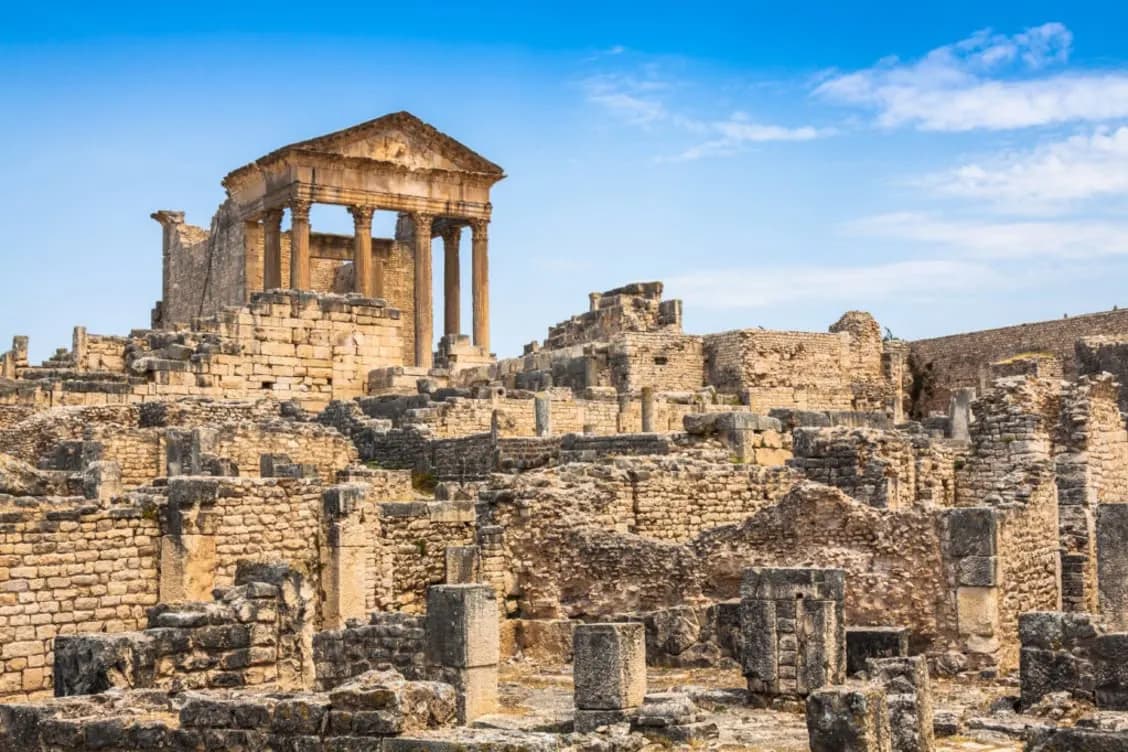
Dougga does not ask you to imagine much. Climb the hill above the Oued Khalled valley and a whole Roman town assembles around you — paved streets, doorways, temples and baths, left roughly where Rome set them down. This is Thugga, the best-preserved Roman town in North Africa, and you walk it rather than peer at it from behind a rope.
Start at the Capitol. The 2nd-century temple to Jupiter, Juno and Minerva still lifts its soaring portico against the sky; stand back at the edge of the forum and it reads exactly as intended — the anchor of the whole town. Then drop to the theatre, cut into the slope with seating for about 3,500 and still used for festivals, so the stone rows have not quite fallen silent. Climb to the top tier for the town and the plains in one sweep.
Where to stand, what to look for
- The Square of the Winds — find the compass rose carved into the paving, naming the winds that crossed the valley.
- The Licinian Baths — trace the room-to-room route bathers once followed through the complex.
- The brothel and the communal latrines — blunt, human details that make daily life here suddenly vivid.
- The Libyco-Punic Mausoleum of Ateban — a rare pre-Roman Numidian monument standing apart from the Roman core.
Give it half a day and wear proper shoes: the hillside is uneven, stony and open, with little shade. Dougga lies about 100 km southwest of Tunis, near Teboursouk in the interior. Come early, when low light rakes across the Capitol's columns and you have the streets largely to yourself.