
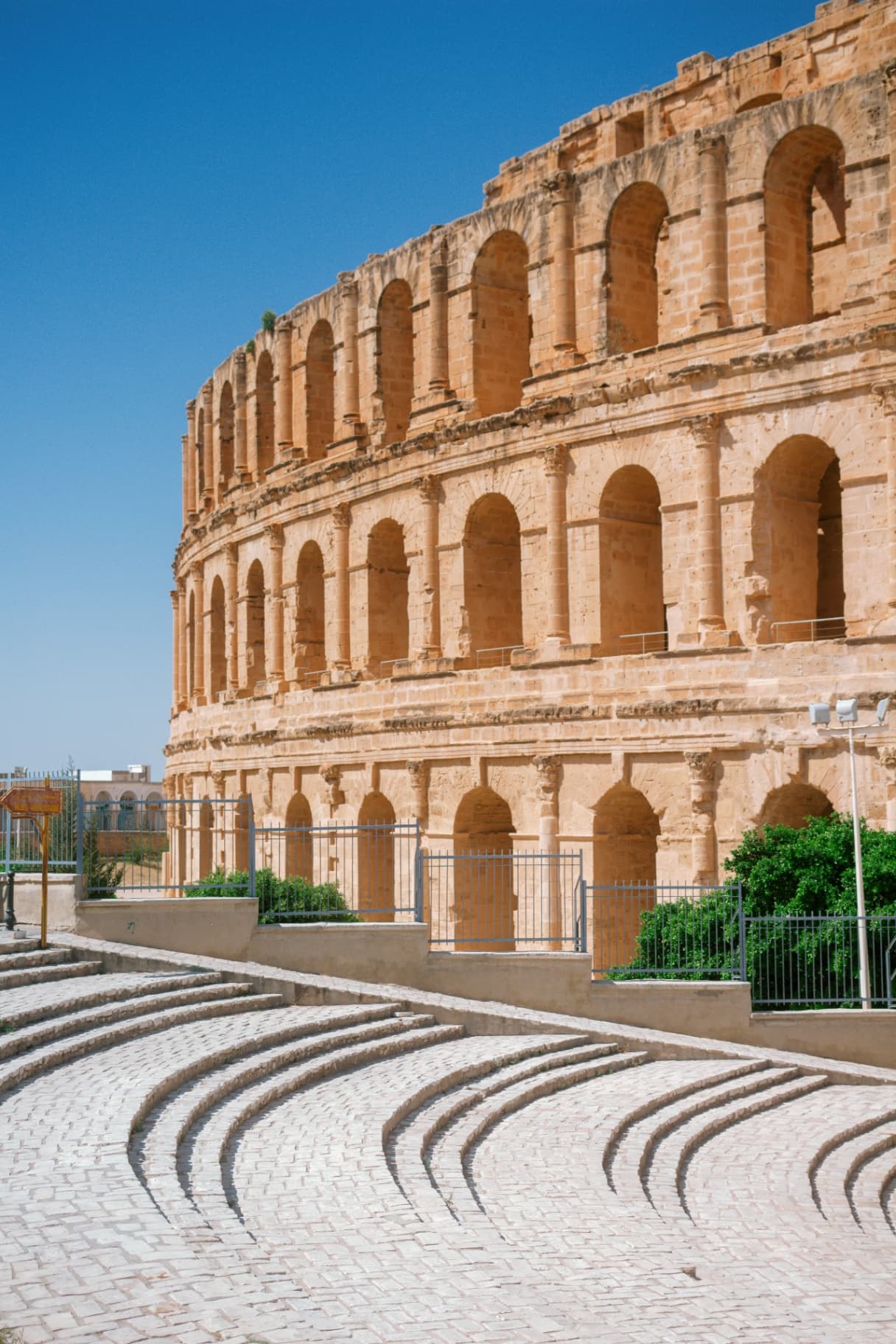
A ring of stone rising from the plain
You see it long before you reach it. The land here is flat and low, all olive rows and pale dust, and then a wall of honey-coloured stone lifts clean out of the horizon as if it had been set down by mistake. There is no hill under it, no river beside it, no reason on the surface of things for something this large to be here at all. That is the first surprise of El Jem: the sheer improbability of the scale.
Come closer and the wall resolves into arches — tier on tier of them, three levels of arcades stacked one above the other, the top rim broken and open to the sky. Locals call it the Colosseum of Africa, and standing in its shadow the nickname stops feeling like tourist-board copy. At roughly 148 by 122 metres, this is one of the largest Roman amphitheatres anywhere, and unlike its cousin in Rome it stands almost alone, ringed not by a modern city but by a small Tunisian town that seems to go about its day as if the monument were simply another neighbour.
Walk in through one of the ground-level arches and the town noise falls away. The oval opens around you, and it is easy to forget you are looking at ruins. The stone is warm. The acoustics are strange and good. And the arena floor, when you reach it, is not sand at all but a grid of exposed passages — the underground of the building, laid bare.
Olive oil and a Roman boomtown — ancient Thysdrus
The amphitheatre is the survivor, but it was never the point. The point was oil. In Roman times this town was called Thysdrus, and it sat at the centre of one of the richest olive-growing regions of the empire, in the province of Africa Proconsularis. Oil pressed here was shipped across the Mediterranean, and the money it made came home in stone: paved streets, grand houses, and floors carpeted in mosaic.
Prosperity on that scale explains the amphitheatre. A town does not build a 35,000-seat arena unless it has both the wealth to pay for it and the ambition to announce itself. Thysdrus had both. The building we see today is usually dated to around the third century AD, and it was the third or fourth structure of its kind on the site — each one grander than the last, as if the town kept outgrowing its own theatres.
The revolt of 238 AD
Thysdrus has one genuinely dramatic moment in the historical record, and it is a strange one. In 238 AD the local landowners, crushed by heavy imperial taxation, rose in revolt. Looking for a figurehead, they turned to the elderly provincial governor and proclaimed him emperor on the spot: Gordian I.
It did not go well. Gordian's reign is counted in weeks — roughly three of them — before the revolt was crushed and the imperial order restored. For a town on the edge of the empire it was a spectacular, doomed gesture, and it is tempting to read the unfinished upper works of the amphitheatre against that backdrop: a boomtown that reached, overreached, and never quite completed what it started.
UNESCO World Heritage, 1979
El Jem was inscribed on the UNESCO World Heritage List in 1979 — the same year Tunisia saw Carthage and the Medina of Tunis added. That places the amphitheatre in the first rank of the country's monuments, and it is part of why the site has been stabilised and studied rather than quarried away, which is the fate that met so much Roman stone elsewhere.
A town does not build a 35,000-seat arena unless it has both the wealth to pay for it and the ambition to announce itself.
The Colosseum of Africa — how to walk the amphitheatre
There is no single right way through, but there is a sequence that makes the building legible. Start low, go lower, then climb. Give yourself time at each level; the pleasure of El Jem is that you can, because it is rarely as crowded as it deserves to be.
The arena floor
Enter at ground level and make for the centre of the oval. Standing on the arena floor, you get the measure of the place: the tiers rising around you, the broken rim above, the long axis running away in both directions. This is where the spectacle happened — beast hunts, executions, gladiatorial games — and the sightlines are engineered so that tens of thousands of people could all see the same patch of ground.
The underground passages
Beneath the arena run two long service corridors, and you can walk them. This is where animals were caged and fighters waited before being raised into the light. The passages are narrow, cool, and unadorned, and they do more to conjure the reality of the games than any signboard — the claustrophobia, the darkness, the seconds before the floor above filled with noise. It is the single most atmospheric part of the visit.
The upper tiers
Then climb. The stairways lead up through the three levels of arcades toward the surviving top of the structure, and the reward is the view: the full oval below you, the town spreading out beyond the walls, and the flat plain running to the horizon in every direction. Watch your footing — the stone is uneven and there are open drops with little in the way of railings. Take the height slowly and it is worth every step.
The archaeological museum — Roman daily life in mosaic
Do not leave without the museum. A short distance from the amphitheatre, the El Jem archaeological museum holds one of Tunisia's finest collections of Roman mosaics — the floors that once carpeted the villas of wealthy Thysdrus, lifted and displayed. Where the amphitheatre gives you the scale of Roman power, the mosaics give you its texture: hunting scenes, sea creatures, banquets, the seasons, the everyday luxury of a town grown rich on oil.
Beside the museum lies the excavated "House of Africa," a Roman villa uncovered in situ, so you can see mosaics in something closer to their original setting rather than remounted on a wall. Together the two sites round out the visit — the arena for the grand gesture, the museum for the human detail. Budget an extra hour if you want to do it justice.
Summer nights, when the arena becomes a concert hall
In July and August the amphitheatre changes character entirely. It becomes a stage. The El Jem International Symphonic Music Festival brings orchestras into the arena for evening concerts, and audiences sit on the ancient tiers under the stars while music fills a space built for very different spectacles. The acoustics that once carried the roar of the crowd carry a symphony instead.
If your visit falls in high summer, it is worth checking the festival programme — hearing an orchestra inside a 1,800-year-old Roman amphitheatre is a rare thing, and the setting does most of the work. Concerts are evening events, which also pairs neatly with a daytime plan built around beating the heat: see the stone in the cool of the morning, return for the music after dark.
Visiting El Jem
El Jem sits mid-plain, roughly between Sousse and Sfax and about 200 km south of Tunis, which historically made it a slightly awkward day out. On a Tunisia Trip itinerary that problem disappears: your transfer is arranged, so you arrive rested and on your own schedule rather than negotiating timetables. The advantage that buys you is timing — and at El Jem, timing is everything.
The monument is compact enough to see the essentials in a couple of hours, but it rewards a slower pace. Plan on roughly two hours for the amphitheatre alone and a half-day if you add the museum. Wear proper shoes, because the stone is uneven and you will be climbing; bring water and sun cover, because shade on site is limited.
When to go, and what to bring
The plain is hot and open, and the amphitheatre offers little relief once the sun is up. Season and time of day matter more here than at most sites.
- Best seasons: spring (roughly March–May) and autumn (September–November), when the light is kind and the heat is manageable.
- In summer, go at opening. By late morning the stone is baking and the upper tiers become genuinely uncomfortable.
- Wear sturdy, closed shoes with grip — the surfaces are uneven and the stairways are steep.
- Bring water and sun protection: a hat, sunglasses, and sunscreen. Shade on site is minimal.
- Allow about two hours for the amphitheatre, or a half-day if you add the museum and the House of Africa.
- In July–August, check the symphonic festival programme if you would like an evening concert in the arena.
Roman sites to pair with El Jem
El Jem is the headline act, but Tunisia's Roman inheritance is deep, and the country makes it easy to string several sites into one trip. If the amphitheatre leaves you wanting more, these three are the natural companions.
- Dougga — the best-preserved Roman town in North Africa, spread across a hillside with its capitol, theatre and temples largely intact. A UNESCO site and a strong contrast to El Jem's single monumental focus.
- Sbeitla (ancient Sufetula) — a remarkable forum with three temples standing side by side, set among olive groves in the centre of the country.
- Carthage — the great Punic and Roman city on the coast near Tunis, UNESCO-listed in the same 1979 cohort as El Jem, and the place to grasp the wider story of Roman Africa.
By the numbers — El Jem vs Rome's Colosseum
| El Jem | Rome's Colosseum | |
|---|---|---|
| Built | ~238 AD (never completed) | 72–80 AD |
| Capacity | ~35,000 spectators | ~50,000 spectators |
| Dimensions | ~148 × 122 m | ~189 × 156 m |
| Height | ~36 m | ~48 m |
| Levels of arcades | Three | Three (plus attic) |
Half a day at El Jem
- 08:00 Arrive at opening — Step into the amphitheatre while it is still cool and near-empty. Walk straight to the centre of the arena floor to take in the full scale before anyone else arrives.
- 08:20 The underground passages — Descend into the two service corridors beneath the arena, where animals and fighters once waited. The most atmospheric part of the site, and best experienced before the crowds.
- 08:50 Climb the tiers — Work your way up through the three levels of arcades to the surviving upper rim for the classic view down the long axis and out over the plain. Mind the uneven stone and open drops.
- 09:40 Circle the exterior — Step outside the walls to photograph the stacked arches in the morning light and appreciate how the building rises straight from the flat town around it.
- 10:15 The archaeological museum — Head to the nearby museum for its Roman mosaics and the adjacent House of Africa excavation — the domestic, everyday counterpoint to the amphitheatre's grandeur.
- 11:30 Coffee in town — Finish with a coffee in El Jem itself, watching everyday life go on in the shadow of the monument before your onward transfer.
Access & essentials
| Entry | ~12 TND (local price, verify on arrival) |
|---|---|
| Hours | Typically daylight hours, roughly 8:00 to sunset (verify seasonally) |
| Access | Transfer included in your Tunisia Trip itinerary |
| Best season | Spring and autumn; in summer, arrive early in the morning |
| Facilities | Limited shade and water on site — bring your own |
| Region | Mid-east, semi-arid climate |
| Map | View location on Google Maps |
On a July morning in 2026, arriving just after opening, the arena was completely empty. The town was barely awake, the light was still low and gold, and for the better part of twenty minutes I had the whole oval to myself — footsteps echoing off three storeys of stone, the underground passages cool and dim, not another visitor in sight. By the time the first coach pulled up, I was already climbing the upper tier with the plain opening out below. Arrive at eight and El Jem gives you something the midday crowds never see: silence.
Frequently asked questions
Is El Jem worth visiting?
Yes. It is the best-preserved Roman amphitheatre in North Africa and one of the largest anywhere, held about 35,000 spectators, and is UNESCO-listed. Few Roman monuments let you walk the arena floor, the underground passages and the upper tiers as freely as this one.
How long do I need to visit El Jem?
Allow about two hours for the amphitheatre itself, and a half-day if you also visit the archaeological museum and the House of Africa excavation nearby.
How much is entry to El Jem?
Entry is a modest local price, around 12 TND, though prices change — verify on arrival. On a Tunisia Trip itinerary the visit is built into your plan, with the transfer included.
What is the best time of day and season to visit?
Spring and autumn are the most comfortable seasons. Whatever the season, arrive at opening: early morning gives you cool stone, soft light and an empty arena before the coaches and the midday heat arrive.
Is El Jem the biggest amphitheatre in Africa?
It is the largest Roman amphitheatre in North Africa and one of the largest in the entire Roman world — roughly 148 by 122 metres, about 36 metres high, with three levels of arcades. It was, however, never completed.
Can you go underground at El Jem?
Yes. Two long service passages run beneath the arena floor, where animals and gladiators were held before the games, and visitors can walk through them. It is the most atmospheric part of the site.
Is El Jem the amphitheatre from the film Gladiator?
No — that is a common question, but Gladiator's arena scenes were filmed elsewhere, with the Colosseum recreated on sets and with effects. El Jem is a genuine, standing Roman amphitheatre you can walk through in person, which is arguably more impressive.
Is the archaeological museum worth it?
Very much so. It holds one of Tunisia's finest collections of Roman mosaics, lifted from the villas of ancient Thysdrus, plus the adjacent House of Africa excavation. It is the perfect complement to the amphitheatre — the everyday life behind the monumental scale.
When is the El Jem music festival?
The El Jem International Symphonic Music Festival takes place inside the amphitheatre in July and August, with evening orchestral concerts on the ancient tiers. If you visit in high summer, check the programme for dates.
How do I get to El Jem?
El Jem lies mid-plain, roughly between Sousse and Sfax and about 200 km south of Tunis. On a Tunisia Trip itinerary you do not need to worry about the logistics — your transfer is included, so you arrive on your own schedule and can time your visit for the quiet early morning.