
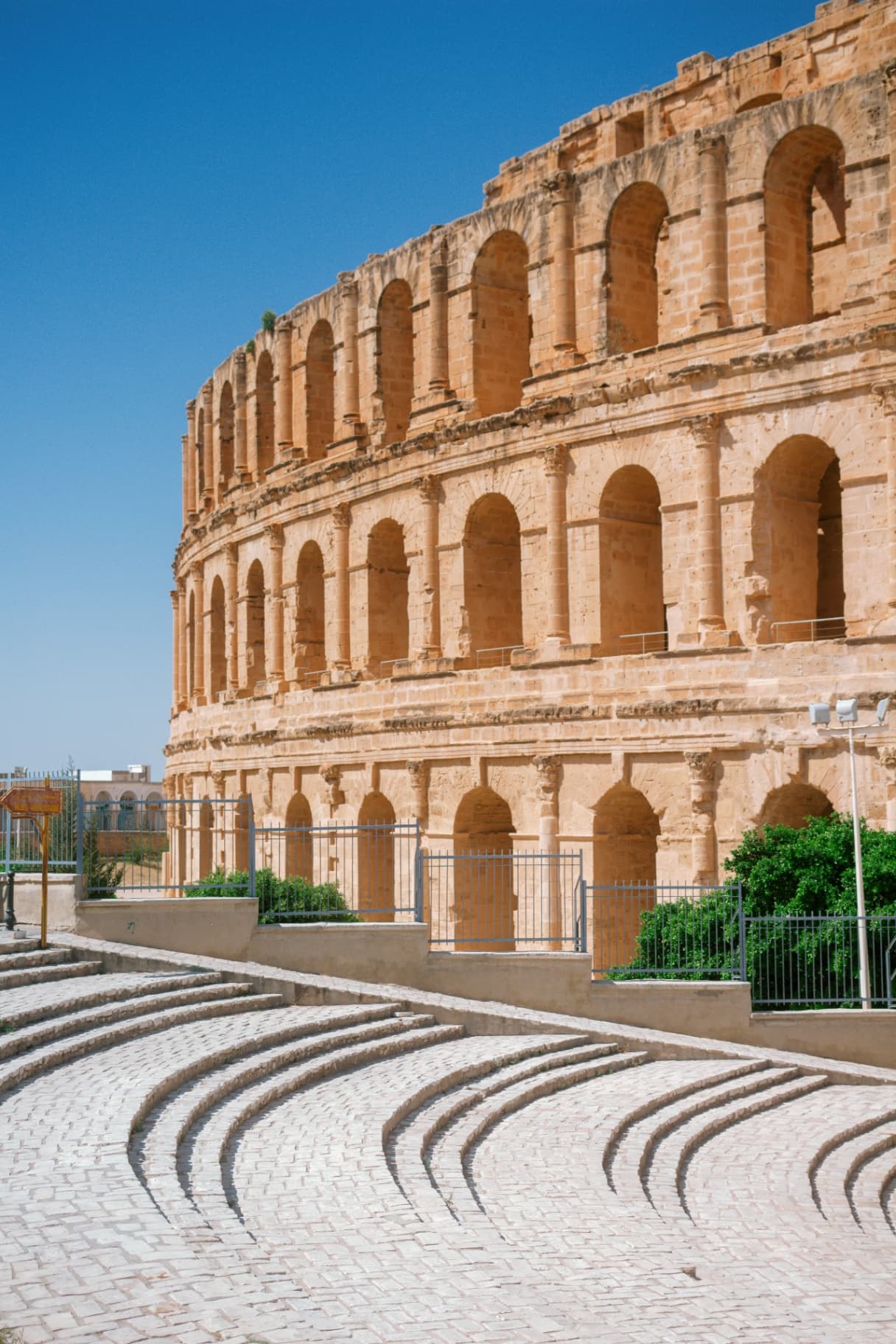
Walk in through a ground-level arch and make straight for the centre of the oval. From the arena floor the scale of El Jem lands all at once: three tiers of arcades rising around you, the broken upper rim open to the sky. This was Roman Thysdrus, and the amphitheatre — one of the largest in the Roman world, built for roughly 35,000 spectators — is exceptionally well preserved, so you can read the whole building from where you stand.
The stone went up in the early third century AD, around 238, tied to a local revolt that proclaimed Gordian I emperor against Maximinus Thrax. The revolt failed; the amphitheatre endured, and has been a UNESCO World Heritage Site since 1979.
Where to stand, what to look for
Do three things in order. Descend into the underground passages beneath the arena, narrow and cool, where gladiators and animals once waited to be raised into the light — the most atmospheric corner of the site. Come back up and climb the tiers to the surviving rim for the long view down the axis and out over the flat plain. Then walk the short distance to the small archaeological museum, whose fine mosaics show the everyday luxury of the town that paid for all this.
- Getting there: El Jem is an easy day trip about 60 km south of Sousse, and sits on the Tunis–Sfax rail line, so you can arrive by train.
- Timing: come early, when the stone is still cool and the arena is near-empty.
- Footwear: the surfaces are uneven and the stairways steep — wear closed shoes with grip.
- Bring water and sun cover; shade on site is limited.
- Allow around two hours for the amphitheatre, longer if you add the museum.