
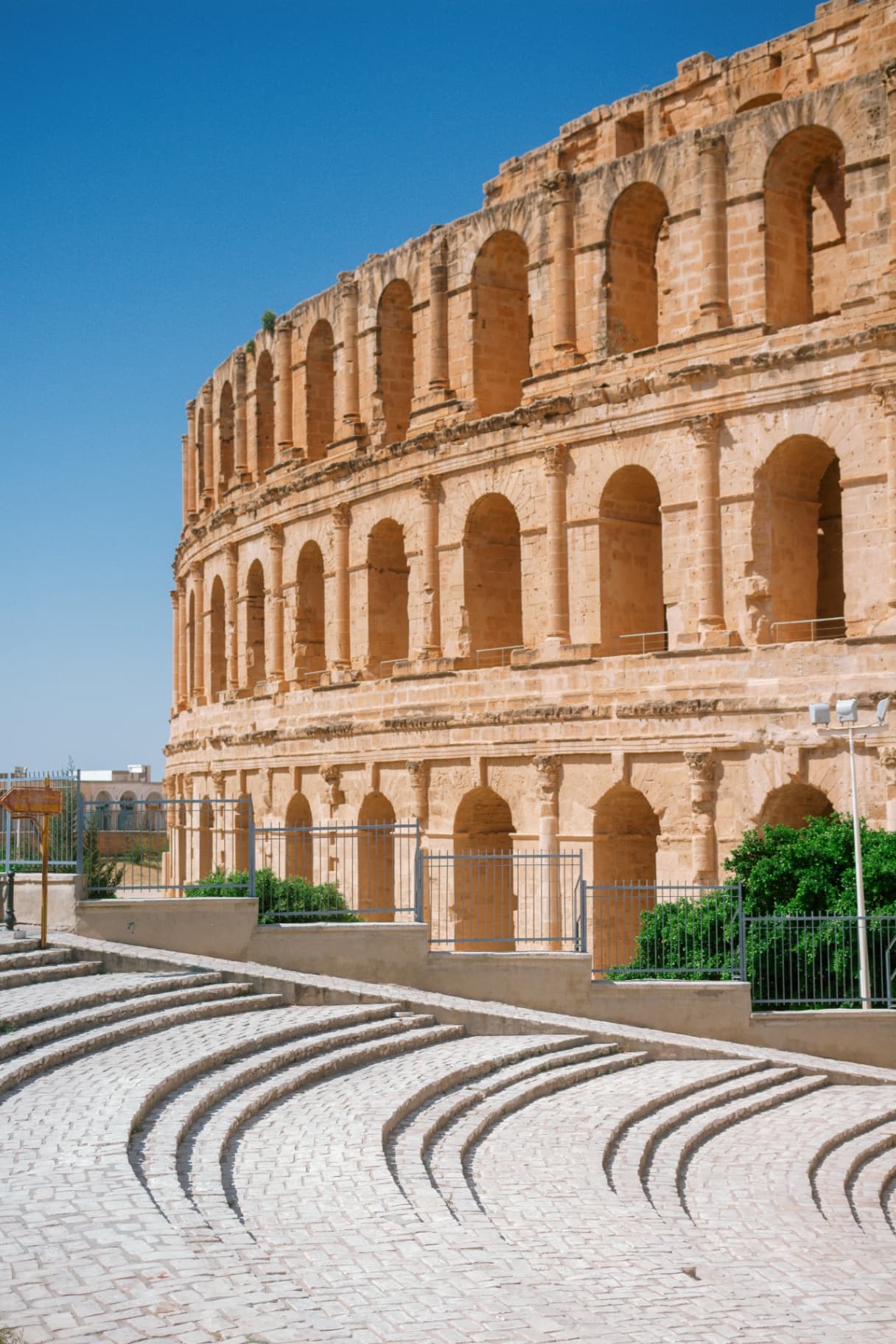
Rising out of a small Tunisian town, almost perfectly intact, stands one of the largest Roman amphitheatres ever built — a Colosseum of the desert that still takes your breath away.
The Amphitheatre of El Jem (ancient Thysdrus), in central Tunisia, is one of the largest and best-preserved Roman amphitheatres in the world and a UNESCO World Heritage Site since 1979. Built around 238 AD, it could hold up to 35,000 spectators. Its three towering tiers of arches still stand, and you can walk the arena floor and the underground chambers where gladiators and animals once waited.
What is the El Jem amphitheatre?
El Jem (also spelled El Djem) is a modest town in the central Tunisian plain, about 60 km south of Sousse and 200 km from Tunis. In Roman times it was Thysdrus, a wealthy city grown rich on olive oil — and that wealth paid for a colossal stone amphitheatre that dwarfs the town around it. Walk out of the little streets and it simply appears: three storeys of golden arches, a Roman monument on the scale of the Colosseum, standing in the middle of everyday Tunisian life.
It is the single most spectacular Roman ruin in the country and, for many visitors, the highlight of a trip to Tunisia.
A Colosseum in Africa
The El Jem amphitheatre is often ranked among the three largest in the Roman world, after the Colosseum in Rome and the amphitheatre of Capua. Its oval measures roughly 148 by 122 metres, and its tiers of seating could hold up to 35,000 people — far more than the entire modern town. It was built mainly of large stone blocks (unlike many amphitheatres that reused brick and concrete), which is part of why so much of it survives.
What makes it extraordinary today is its completeness. Much of the outer wall still rises to its full three storeys of arcades. You can climb through the galleries, sit high on the surviving tiers looking down into the arena, walk out onto the arena floor itself, and descend into the underground passages — the two long chambers beneath the arena where gladiators, prisoners and wild animals were held before being hoisted up into the daylight. Few Roman arenas anywhere let you experience all of that.
How El Jem compares to the Colosseum
Visitors inevitably think of Rome — and the comparison is fair. El Jem is smaller than the Colosseum but built on the same ambitious scale, and in some ways it is a better experience to visit. It is far less crowded, you can walk freely across the arena floor and down into the underground passages rather than viewing them from behind barriers, and the honey-coloured stone glows beautifully in the low African sun. Where the Colosseum is hemmed in by a modern city, El Jem rises almost alone above a quiet town, so you grasp its sheer scale at a glance. For many travellers it is the more memorable of the two.
A short history of Thysdrus
Thysdrus boomed in the 2nd and 3rd centuries AD as the centre of a rich olive-growing region, exporting oil across the empire. The great amphitheatre was begun around 238 AD under the local proconsul Gordian — who was briefly proclaimed emperor at Thysdrus itself during a revolt against Rome. That revolt failed, Gordian died, and the building may never have been entirely finished; but it was used for spectacles for generations.
As Roman power faded, the amphitheatre took on a second life as a fortress and refuge during the Vandal and later Arab-era conflicts. Legend ties it to the Berber queen Al-Kahina, said to have made a last stand here against the Arab armies in the 7th century. Over the centuries stone was quarried from it, but the core survived — and today it is protected, restored and inscribed on the UNESCO World Heritage List.
What to see at El Jem
The amphitheatre is the star, but there is more to the site.
The arena and the galleries
Give yourself time to climb. The upper tiers give the classic view down into the oval; the galleries and stairways let you circle the building as Roman crowds once did; and the arena floor puts you where the gladiators stood, looking up at the ranks of seats.
The underground chambers
Beneath the arena run the two service tunnels where combatants and animals waited. Standing down there, in the cool and the shadow, is one of the most atmospheric experiences in Roman Tunisia — the practical, brutal machinery behind the spectacle.
The El Jem Archaeological Museum
A short walk from the amphitheatre, the El Jem Museum displays superb mosaics excavated from the villas of wealthy Thysdrus, along with a partly reconstructed Roman house. It is the perfect complement to the arena, showing the domestic luxury that the olive-oil fortunes paid for. For the country's greatest mosaic collection, pair it with the Bardo Museum in Tunis.
The El Jem music festival
Every summer the amphitheatre hosts the International Festival of Symphonic Music of El Jem, with orchestras performing by night inside the floodlit Roman walls. If your visit falls in July, an evening concert in a 1,800-year-old arena is an unforgettable way to experience the monument.
Visiting El Jem
El Jem is easy to reach and makes a straightforward day trip or a stop on the way south.
- Getting there: El Jem is on the main Tunis–Sfax railway line, so it is one of the few major sites reachable by train; it is also an easy drive from Sousse, Monastir or Mahdia (under an hour), or about 3 hours from Tunis.
- Tickets: a single modest fee usually covers both the amphitheatre and the museum. Bring cash.
- Time needed: about 1.5–2 hours for the amphitheatre, plus 30–45 minutes for the museum.
- When to go: early morning or late afternoon are best for light and to avoid the midday heat — there is almost no shade on the upper tiers. Spring and autumn are ideal.
- What to bring: sturdy shoes for the worn stone steps, water, a hat and sun protection.
El Jem combines naturally with the coastal cities of Sousse and Monastir, and with an inland route toward the Roman sites of the north.
El Jem and Tunisia's other ancient sites
El Jem is one of Tunisia's ten UNESCO World Heritage Sites, alongside Carthage, the complete hilltop town of Dougga, Kairouan and Sousse. The amphitheatre shows the grandeur of Roman public life; Dougga shows a whole town; the Bardo shows the art that filled their homes; and Kerkouane shows the Punic world that came before. See how they all connect in our complete guide to UNESCO sites in Tunisia. For a more personal account, read our day at the arena in Beneath the Arcades.
Atlantis Voyages can build a tailor-made itinerary that links El Jem with the coast and the great Roman sites — browse our Tunisia tours or start planning your trip.
Frequently asked questions
What is El Jem famous for?
For its vast, remarkably well-preserved Roman amphitheatre — one of the largest in the world — standing in the middle of a small Tunisian town.
Where is El Jem?
In central Tunisia, about 60 km south of Sousse and roughly 200 km south of Tunis, on the Tunis–Sfax railway line.
Is El Jem a UNESCO World Heritage Site?
Yes. The amphitheatre of El Jem was inscribed on the UNESCO World Heritage List in 1979.
How big is the El Jem amphitheatre?
Its oval measures about 148 by 122 metres, and it could hold up to around 35,000 spectators — making it one of the three largest in the Roman world.
When was El Jem built?
Around 238 AD, under the local proconsul Gordian, during the height of Roman Thysdrus's olive-oil prosperity.
Can you go inside and underground at El Jem?
Yes — you can climb the tiers, walk the arena floor, and descend into the underground chambers where gladiators and animals were held.
How do you get to El Jem?
By train on the Tunis–Sfax line, by car from Sousse, Monastir or Mahdia (under an hour), or about 3 hours' drive from Tunis.
How long do you need at El Jem?
About 1.5–2 hours for the amphitheatre, plus another 30–45 minutes for the nearby archaeological museum.
Is there a museum at El Jem?
Yes — the El Jem Archaeological Museum displays outstanding Roman mosaics and a reconstructed villa, a short walk from the amphitheatre.
Was Gladiator filmed at El Jem?
No. Despite its Colosseum-like appearance, El Jem was not the filming location for the arena scenes in Gladiator — but it is exactly the kind of monument those scenes evoke.
Is El Jem worth visiting?
Absolutely — it is the most spectacular Roman monument in Tunisia and one of the finest amphitheatres surviving anywhere.
Can you attend a concert at El Jem?
Yes — each July the amphitheatre hosts an international symphonic music festival, with concerts staged by night inside the floodlit Roman walls.
When is the best time to visit El Jem?
Spring and autumn for comfortable weather; within the day, early morning or late afternoon for the best light and to avoid the midday heat.
How does El Jem compare to the Colosseum in Rome?
It is somewhat smaller but built on a similar scale, and far less crowded — you can walk the arena floor and the underground chambers freely, which makes it a remarkably immersive visit.
What was Thysdrus?
The Roman name for El Jem — a city that grew wealthy on olive-oil production in the 2nd and 3rd centuries AD, wealth that paid for the great amphitheatre.
Can you visit El Jem as a day trip from Tunis?
Yes, though it is a long day (about 3 hours each way). It is far easier as a day trip or stop from Sousse, Monastir or Mahdia, all under an hour away.
Are there a lot of stairs at El Jem?
Yes — reaching the upper tiers and the underground chambers involves worn stone steps and uneven ground, so wear sturdy shoes and take care.
Does it cost extra to see the underground chambers?
No — access to the arena floor and the underground passages is normally included in the standard amphitheatre ticket.
Is El Jem suitable for children?
Yes — children usually love the scale, the arena and especially the underground tunnels, though the steps and drops mean they should be supervised closely.
Are guides available at El Jem?
Yes — local guides can usually be found at the site, and a guided visit brings the history, the games and the underground workings vividly to life.
Stand inside a Roman Colosseum. Plan a tailor-made Tunisia trip with Atlantis Voyages, or explore our guided Tunisia tours.