
Older than almost any city in the Islamic world west of Arabia, Kairouan is where Islam first put down roots in North Africa — a holy city of mosques, medinas and master craftsmen set on the edge of the steppe.
Kairouan, in central Tunisia, is the first Islamic city of the Maghreb, founded in 670 AD, and a UNESCO World Heritage Site since 1988. It is home to the Great Mosque of Uqba — one of the oldest and most important mosques in the world — along with the Aghlabid water basins, the Mosque of the Barber, and an atmospheric walled medina famous for its carpets. For many Muslims it ranks among Islam's holiest cities.
What is Kairouan?
Kairouan (al-Qayrawan) is a historic city on the plains of central Tunisia, about 60 km inland from Sousse and roughly 160 km south of Tunis. It was founded in 670 AD by the Arab general Uqba ibn Nafi as a military and religious base for the Muslim conquest of North Africa — making it the oldest Arab-Muslim city in the Maghreb. From here, Islam and Arab culture spread across North Africa and into Spain.
Kairouan went on to become a great centre of learning and faith, especially under the Aghlabid dynasty in the 9th century, when its finest monuments took their present form. Today it is a living religious city and one of Tunisia's most rewarding places to visit — spiritual, atmospheric and far less touristy than the coast.
A holy city
Kairouan is widely described as one of the holiest cities in Islam, and is popularly called the "fourth holiest" after Mecca, Medina and Jerusalem — a traditional honour rather than an official ranking. UNESCO calls it the first holy city of the Maghreb. For centuries pilgrims have come here, and local tradition holds that a number of visits to Kairouan can equal the merit of a pilgrimage for those unable to reach Mecca. That religious weight is still palpable in the city's mosques, shrines and quiet medina streets.
A short history of Kairouan
Kairouan was founded in 670 AD by Uqba ibn Nafi as the launch-pad for the Muslim conquest of the Maghreb. For the next few centuries it was the political and religious capital of Ifriqiya (roughly modern Tunisia), reaching its golden age under the Aghlabid dynasty in the 9th century, when the Great Mosque was rebuilt in its present form, the minaret raised and the great water basins dug. It was one of the leading intellectual centres of the Islamic world, renowned for theology, law and medicine.
Its political star faded when the Fatimids moved their capital to Mahdia and later to Cairo, and the city was devastated in the 11th century during the Hilalian invasions of 1057. But its religious prestige endured, and the monuments of its great age survived. Today Kairouan remains a spiritual capital and a UNESCO-protected treasure, its medieval skyline of minaret and domes little changed.
What to see in Kairouan
The Great Mosque of Uqba
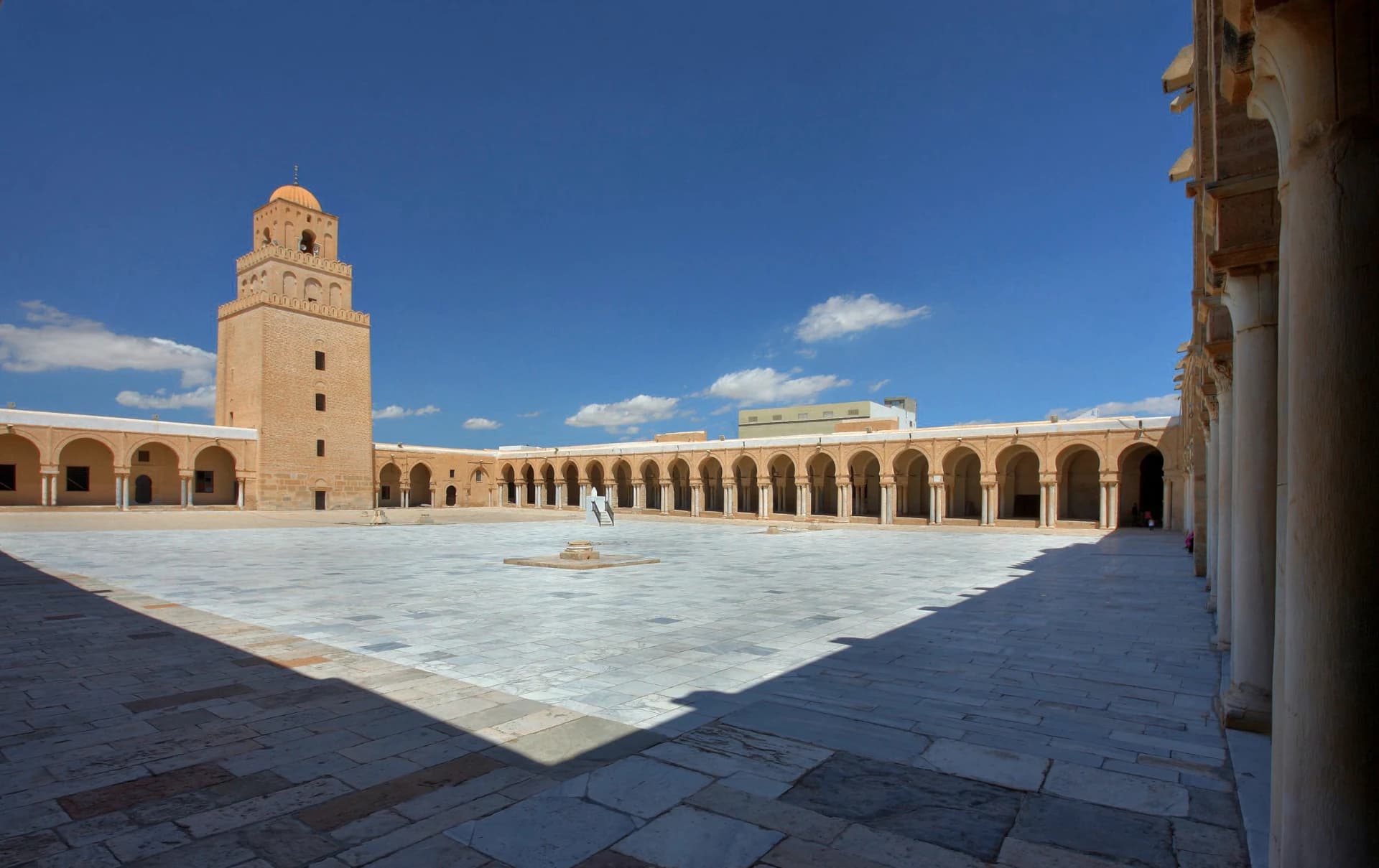
The Great Mosque of Uqba (also called the Mosque of Sidi Okba) is Kairouan's crowning monument and one of the most important mosques in the Islamic world. Founded with the city in 670 and rebuilt over the following centuries, it is a vast fortress-like structure of honey-coloured stone, with a huge arcaded courtyard and a forest of columns — many recycled from Roman and Byzantine ruins — supporting the prayer hall. Its massive square minaret, dating in large part to 836, is among the oldest surviving minarets anywhere and served as a model for mosque towers across the region. Non-Muslim visitors can enter the courtyard and admire the architecture, though not the prayer hall itself.
The Aghlabid Basins
On the edge of the old city lie the Aghlabid Basins, a remarkable feat of 9th-century engineering: great open-air reservoirs that collected and stored rainwater brought by aqueduct, keeping the city supplied through the dry season. The largest is a huge circular pool. They are a vivid reminder of how sophisticated medieval Kairouan was.
The Mosque of the Barber (Zaouia of Sidi Sahab)
One of Kairouan's most beautiful buildings is the Zaouia of Sidi Sahab, popularly known as the Mosque of the Barber. It is the shrine of a companion of the Prophet, and it dazzles with intricate tilework, carved stucco and a serene courtyard. Open to visitors, it is a highlight of any trip.
Bir Barouta
In the heart of the medina is Bir Barouta, a sacred well that legend connects to the holy Zamzam spring of Mecca. Upstairs, a blindfolded camel walks in slow circles to draw its water — an unusual, much-photographed scene that has become one of Kairouan's quirks. Whatever you make of the legend, it is a window onto the city's deep religious identity.
The medina and the souks
Kairouan's walled medina is a maze of white-and-blue houses, mosques and workshops. It is the heart of Tunisia's carpet-making tradition — Kairouan rugs are famous across the country — and the souks are full of weavers, coppersmiths and shops. Don't leave without trying makroudh, the city's signature date-and-semolina pastry soaked in honey.
Kairouan and Tunisia's other heritage
Kairouan is one of Tunisia's ten UNESCO World Heritage Sites. Where El Jem and Dougga tell the Roman story, and Kerkouane the Punic one, Kairouan opens the Islamic chapter of Tunisian history — the arrival of a new faith, language and architecture that still shape the country today. See how all the sites connect in our complete guide to UNESCO sites in Tunisia.
Visiting Kairouan
- Getting there: about 1 hour by road from Sousse or Monastir, and around 2.5–3 hours from Tunis. It is a popular day trip, but an overnight stay lets you feel the city after the tour buses leave.
- Tickets: a single combined ticket usually covers the main monuments (Great Mosque courtyard, Aghlabid Basins, Mosque of the Barber); buy it at the tourist office. Bring cash.
- Dress: this is a conservative, deeply religious city — dress modestly, with shoulders and knees covered, especially at the mosques and shrines.
- Time needed: at least half a day for the main sites; a full day to include the medina and souks at a relaxed pace.
- When to go: spring and autumn are most comfortable; the central plains are very hot in summer.
A local guide is invaluable in Kairouan, helping you navigate the medina and understand the religious significance of each site.
Atlantis Voyages can build a tailor-made itinerary that links Kairouan with El Jem, the coast and the great Roman sites — browse our Tunisia tours or start planning your trip.
Frequently asked questions
What is Kairouan famous for?
For being the first Islamic city in North Africa, home to the great Mosque of Uqba, and one of the holiest cities in Islam — as well as for its medina and its famous carpets.
Where is Kairouan?
In central Tunisia, about 60 km inland from Sousse and roughly 160 km south of Tunis.
Is Kairouan a UNESCO World Heritage Site?
Yes. Kairouan was inscribed on the UNESCO World Heritage List in 1988 for its exceptional Islamic heritage.
Why is Kairouan a holy city?
Because it was the first Muslim city founded in the Maghreb (670 AD) and became a major centre of Islamic faith and learning. It is popularly regarded as one of Islam's holiest cities.
Is Kairouan the fourth holiest city in Islam?
It is often called the fourth holiest, after Mecca, Medina and Jerusalem, but this is a traditional honour rather than an official ranking.
Can non-Muslims visit the Great Mosque of Kairouan?
Yes — non-Muslim visitors can enter the courtyard and view the architecture and the famous minaret, though access to the prayer hall itself is reserved for worshippers.
How do you get to Kairouan?
By road — about 1 hour from Sousse or Monastir and 2.5–3 hours from Tunis. Many people visit on a day trip from the coast.
How long do you need in Kairouan?
At least half a day for the main monuments; a full day if you also want to explore the medina and souks.
What should I wear in Kairouan?
Modest dress — shoulders and knees covered — out of respect, as Kairouan is a conservative and religious city.
What are the Aghlabid Basins?
Large open-air reservoirs built in the 9th century to collect and store rainwater for the city, an impressive example of medieval engineering.
What is Kairouan's local speciality?
Makroudh — a diamond-shaped pastry of semolina filled with dates and soaked in honey — along with its world-famous hand-knotted carpets.
Can you visit Kairouan as a day trip?
Yes — it is an easy and popular day trip from Sousse, Monastir or Hammamet, and can be combined with El Jem on the way.
Is Kairouan worth visiting?
Very much so — it offers a completely different, spiritual and historic side of Tunisia, away from the beaches, and is unmissable for anyone interested in Islamic heritage.
When was Kairouan founded?
In 670 AD (50 AH), making it the oldest Arab-Muslim city in North Africa.
Who founded Kairouan?
The Arab general Uqba ibn Nafi, who established it as a base during the Muslim conquest of the Maghreb. The Great Mosque is named after him.
What is Bir Barouta?
A sacred well in the medina, linked by legend to the Zamzam spring of Mecca, where a blindfolded camel traditionally draws the water.
Is Kairouan safe to visit?
Yes — Kairouan is a welcoming city routinely visited by tourists. Dress modestly and respect its religious character, as you would at any holy site.
Can you combine Kairouan with El Jem?
Yes — the two sit on a natural route inland from the coast and are frequently combined on a single day trip or a longer heritage circuit.
Why is the minaret of Kairouan important?
The square minaret of the Great Mosque, largely dating to 836, is among the oldest surviving minarets in the world and became a model for mosque towers across North Africa and Spain.
What is the best time of year to visit Kairouan?
Spring (March–May) and autumn (September–November), when the central plains are pleasantly warm. Summer can be extremely hot.
Is Kairouan good for shopping?
Yes — it is Tunisia's carpet capital, and the souks are also known for leather, copperware and the local makroudh pastries.
Is Kairouan suitable as an overnight stay?
Yes — staying overnight lets you experience the medina in the quiet early morning and evening, once the day-trip crowds have left, and there are characterful guesthouses inside and near the old city.
Do you need a guide in Kairouan?
Not strictly, but a local guide greatly enriches a visit — helping you navigate the medina and understand the religious and historical significance of each monument.
Discover Tunisia's holy city. Plan a tailor-made Tunisia trip with Atlantis Voyages, or explore our guided Tunisia tours.