
A capital that Rome destroyed, then rebuilt
Stand on the seafront at the Baths of Antoninus and two cities lie beneath your feet at once. The first was Phoenician Carthage, a maritime superpower that Rome ground into rubble in 146 BC. The second is the Roman city raised on the same shore a century later, capital of the province of Africa Proconsularis, whose bath columns still tower over the Gulf of Tunis.
This is the honest truth about Carthage, and it is worth saying early: there is no single vast monument here, no Colosseum standing whole. Rome saw to that. What survives is spread across a leafy residential suburb — a bath complex here, a hilltop museum there, two silent harbours, a scatter of cisterns and villas — each behind its own fence. The reward is not one photograph but a layered story you walk through, with the sea always close.
It is also the easiest headline site in Tunisia to reach, sitting just north of central Tunis. That makes Carthage a natural first or last day of a trip, and a natural pairing with the blue-and-white cliff village of Sidi Bou Saïd, which is quite literally next door.
Phoenician Carthage — a sea power, and its fall in 146 BC
Tradition dates the founding of Carthage to 814 BC, when Phoenician settlers from Tyre established a trading colony on this shore. Over the following centuries it grew into the dominant maritime power of the western Mediterranean, its fleets and merchants reaching from North Africa to Spain, Sicily and beyond.
That dominance brought Carthage into a long collision with Rome. Across the three Punic Wars the two powers fought for control of the sea; the name of the general Hannibal belongs to this struggle. In 146 BC the third war ended with the total destruction of the city — Rome razed Carthage to the ground. Little of the Punic city therefore survives above ground, which is precisely why the fragments that remain feel so charged.
The Punic ports — two harbours, now lagoons
The clearest surviving trace of the sea power is its two harbours, which you can still read in the coastline. The Carthaginians built a rectangular commercial harbour for trade and, connected to it, a circular naval harbour ringed with ship-sheds where their war fleet was berthed. Today both survive as quiet lagoons, their distinctive shapes best appreciated with a plan in hand.
Do not expect docks and warehouses — expect water, reeds and outline. Standing at the round port, it takes a little imagination to picture the ranks of warships that once made Carthage feared. That imaginative leap is the whole point of the visit.
Byrsa Hill — the Punic quarter and the museum
Byrsa Hill was the heart of the Punic city — its citadel and highest point — and it is the best place to begin joining the fragments together. Here you can walk among the excavated remains of a Punic residential quarter, streets and house foundations that escaped total erasure, giving a rare ground-level sense of how Carthaginians actually lived.
The hill also carries the national archaeological museum, whose collection gathers finds from across the site — Punic and Roman alike — and helps make sense of what you see outside. Because Byrsa is elevated, it doubles as the site's best viewpoint: the harbours, the coast and the sweep of the modern suburb all lay themselves out below you.
Roman Carthage — the Baths of Antoninus by the sea
When Rome refounded Carthage it became the capital of Africa Proconsularis, one of the wealthiest provinces of the empire, and the city was rebuilt on a grand scale. The single most impressive survival from that era stands right on the shore: the Baths of Antoninus, a 2nd-century AD bathing complex counted among the largest the Romans ever built.
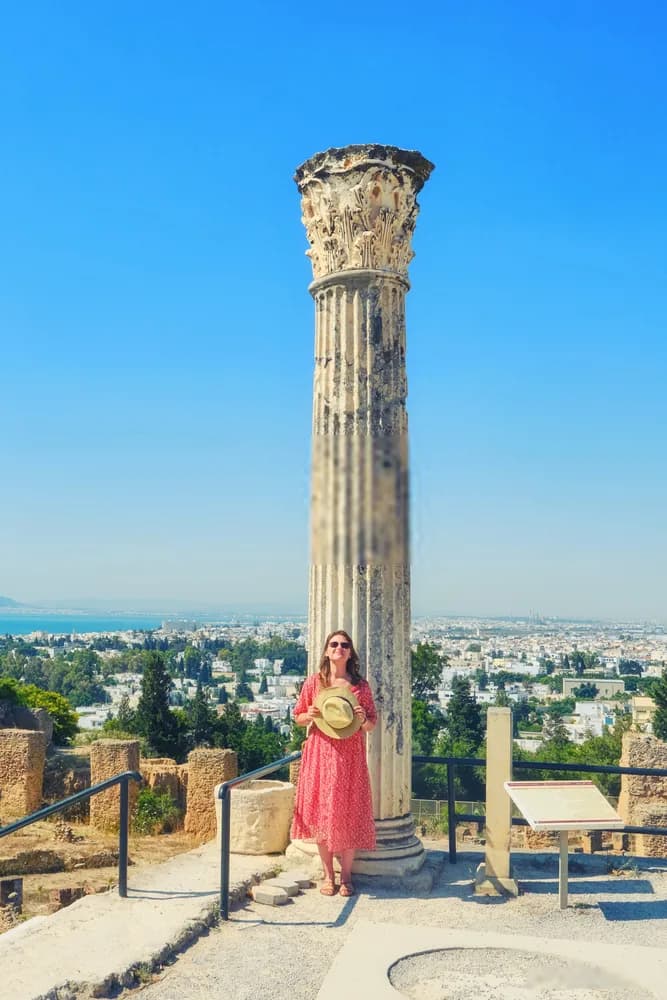
What you see today is mostly the substructure — the service level that once carried the vanished upper floors — but the scale is unmistakable. Massive columns and vaulted chambers rise against the water, and a single re-erected column gives a hint of the original height. Of all the fenced areas, this is the one that most rewards simply standing and looking, with the Gulf of Tunis stretched out behind the ruins.
Seeing Carthage in a day — the site is scattered
The thing to understand before you arrive is that Carthage is not one enclosure but several, dotted through a residential suburb: the Baths of Antoninus, Byrsa Hill, the Punic ports, the amphitheatre, the Roman villas and the cisterns each sit in their own fenced zone, with ordinary houses and streets in between.
A logical route strings them together — Byrsa for the overview and museum, down to the ports, along to the Baths of Antoninus on the shore, with the villas and amphitheatre added if you have time. On a Tunisia Trip itinerary the transfer between these areas is handled for you, so you can concentrate on the sites rather than on navigating the suburb. Half a day covers the highlights comfortably; a full day lets you slow down and add Sidi Bou Saïd.
When to go, and what to bring
Carthage is an open-air, walk-between-fences site with limited shade, so the season and a little preparation matter more than at an indoor attraction.
- Best in spring (roughly March–May) and autumn (September–November), when the coast is warm but not punishing.
- Summer visits are possible but hot and exposed — go early in the day and carry water.
- Wear comfortable shoes: you will cover uneven ground across several separate areas.
- Bring a hat, sunglasses and sunscreen; shade is scarce at the ports and baths.
- Carry water — there are no cafés inside the fenced zones (the cafés are in Sidi Bou Saïd nearby).
- A site map or plan helps enormously in reading the harbours and connecting the scattered areas.
Roman sites to pair with Carthage
Carthage is the gateway to Roman Tunisia rather than its grandest single ruin. If the layered history here whets your appetite, the country holds some of the best-preserved Roman sites in the Mediterranean, most of them a day trip or an overnight from Tunis.
- Sidi Bou Saïd — the blue-and-white cliff village right next door, and the natural other half of a Carthage day.
- El Jem — one of the largest and best-preserved Roman amphitheatres anywhere, and the single most complete monument in Tunisia.
- Dougga — a remarkably intact Roman hill town, widely regarded as the finest in North Africa.
- Sbeitla (Sufetula) — a serene site famous for its trio of Roman temples in the forum.
The two Carthages
| Punic Carthage | Roman Carthage | |
|---|---|---|
| Founded | Traditionally 814 BC | Refounded 1st century BC |
| Who | Phoenician settlers from Tyre | Rome, as capital of Africa Proconsularis |
| Ended | Destroyed by Rome in 146 BC | Declined in late antiquity |
| What survives | The two ports (now lagoons), the Byrsa quarter | Baths of Antoninus, villas, amphitheatre, cisterns |
Carthage in half a day to a full day
- Start Byrsa Hill and the museum — Begin high, on the heart of the Punic city. Walk the excavated Punic quarter, visit the archaeological museum, and use the viewpoint to orient yourself over the whole site.
- Mid-morning The Punic ports — Drop down to the rectangular commercial harbour and the circular naval harbour, now lagoons. A plan in hand makes their shapes come alive.
- Late morning Baths of Antoninus — The set-piece: a huge 2nd-century AD Roman bath complex on the shore, columns and vaults rising against the Gulf of Tunis. Allow the most time here.
- Midday (optional) Villas, amphitheatre and cisterns — With a full day, add the Roman villas, the amphitheatre and the cisterns to round out the Roman city before lunch.
- Afternoon Sidi Bou Saïd — Finish next door in the blue-and-white cliff village — cafés, sea views and shade to close the day.
Access & essentials
| Entry | Single multi-site ticket, around 12 TND (local price), covering the fenced areas — verify on arrival. |
|---|---|
| Hours | Daylight hours; opening times vary seasonally, so verify locally. |
| Access | Transfer included in your Tunisia Trip itinerary. |
| Best season | Spring and autumn for comfortable open-air walking. |
| Facilities | No cafés inside the fenced zones; cafés and restrooms in Sidi Bou Saïd nearby. |
| Region | Greater Tunis, Mediterranean coast |
| Map | View location on Google Maps |
April 2025. We reached the Baths of Antoninus in the late morning, and it is the one part of Carthage that stops you in your tracks. You come through the gate expecting fragments and instead the ruins fall away downhill toward the water, columns and vaulted rooms rising against a flat blue Gulf of Tunis behind them. It is not a whole building — most of what stands is the service level beneath a vanished bathhouse — but the scale and the sea together do the work. We spent longer here than anywhere else on the site, simply following the walkways to the shore and back.
Frequently asked questions
Is there much left to see at Carthage?
Enough to fill half a day, but manage your expectations: Rome destroyed the Punic city in 146 BC, so this is a site of fragments spread across a suburb rather than one giant monument. The Baths of Antoninus, Byrsa Hill and the Punic ports are the standouts, and the layered Punic-plus-Roman history is the real draw.
Is Carthage worth visiting?
Yes, provided you come for the history and the seafront setting rather than for a single spectacular ruin. It is the birthplace of a Mediterranean superpower and the capital Rome built on its ashes, all a short hop from Tunis. Paired with Sidi Bou Saïd, it makes an excellent first or last day of a trip.
How long do I need at Carthage?
Half a day covers the highlights — Byrsa, the ports and the Baths of Antoninus. A full day lets you add the villas, amphitheatre and cisterns and still finish with a relaxed afternoon in Sidi Bou Saïd.
Is there one ticket for all the Carthage sites?
Yes. A single multi-site ticket, typically around 12 TND at local price, covers the fenced areas. Keep it with you, as it is checked at each entrance. Prices and inclusions can change, so verify on arrival.
Can I combine Carthage with Sidi Bou Saïd?
Absolutely, and you should. Sidi Bou Saïd is the blue-and-white cliff village right next to Carthage, and the two are almost always visited together. Ruins in the morning, cafés and sea views in the afternoon.
What is the difference between the Punic and Roman remains?
The Punic remains belong to the original Phoenician city — chiefly the two ports (now lagoons) and the residential quarter on Byrsa Hill. The Roman remains, built after Rome refounded Carthage as capital of Africa Proconsularis, include the Baths of Antoninus, villas, an amphitheatre and cisterns. You walk through both layers on the same visit.
Is Carthage a UNESCO World Heritage Site?
Yes. Carthage has been inscribed on the UNESCO World Heritage List since 1979.
How far is Carthage from Tunis?
Carthage sits on the coast just north of central Tunis and is effectively an easy suburb of the capital — one of the reasons it works so well as the first or last day of a Tunisia trip.
How do I get to Carthage?
On a Tunisia Trip itinerary the transfer is included, and it also carries you between the site's scattered fenced areas and on to Sidi Bou Saïd — so you spend your time on the ruins rather than navigating the suburb.